
Climate programs must have ‘pay-fors’ but combat can be funded by the deficit
Advisory Note for Organizers and Candidates, n°92 | 5 July 2021
If you find these notes useful, you can support this newsletter here and SPRI, here. Sharing these newsletters also helps. Thank you!
Situation
Biden’s infrastructure plan—post-bipartisan agreement—includes $579 billion in new spending. You might’ve heard a $973 billion-over-five-years or $1.2 trillion-over-eight-years deal reported. Those figures include the $579 billion in new spending plus the mandatory transportation spending, which is funded through dedicated trust funds that Congress reauthorizes every five or six years.
The reason you’re hearing about this ‘baseline’ funding just now (or within recent weeks) is probably because Biden’s original plan called for $2.25 trillion in new spending, and adding that baseline amount in there obfuscates just how far Biden negotiated down: Republicans’ initial offer was $257 billion in new spending, meaning that the bipartisan agreement is $322 billion more than Republicans proposed and $1.7 trillion lower than what Biden initially proposed. It’s clear who won the negotiations.
Selective deficit dogmatism
A $1.7 trillion drop in the American Jobs Plan wouldn’t be as catastrophic had Biden not set its starting value as low as he did ($2.25 trillion). Because he wanted it completely ‘paid for’—through taxes and other means—he effectively cut down his own infrastructure plan before Republicans had a chance to do so themselves. Biden wouldn’t need Republican support at all had he opted to pass the infrastructure bill through reconciliation, which would allow Democrats to pass the bill without any Republican votes. But Biden insists on the bill being bipartisan, so here we are.
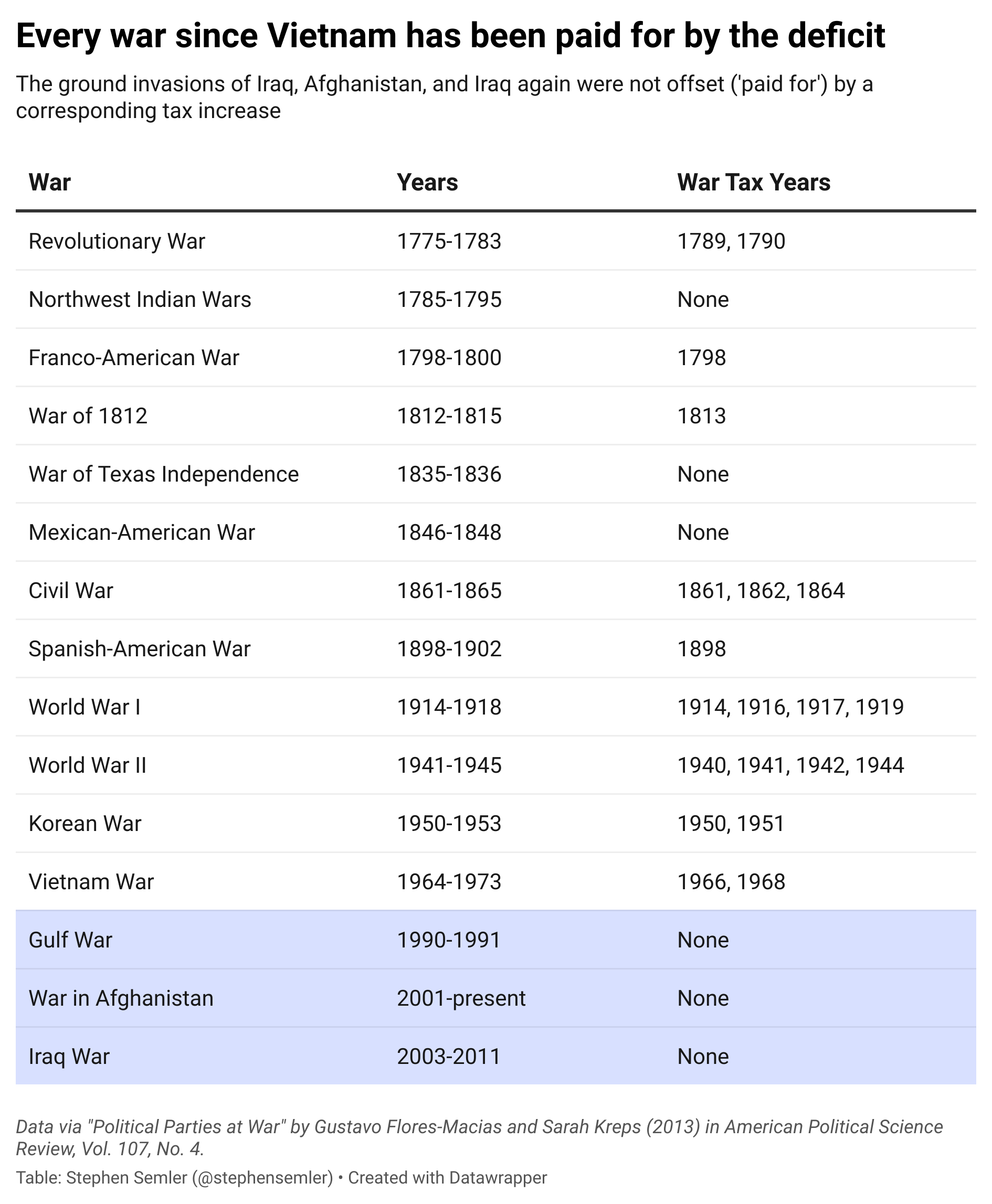
This is irresponsible: this is the bill supposed to address the climate crisis. It’s also hypocritical: neither Biden nor the Republican negotiators ever sought a ‘pay for’ with any of the wars of choice that occurred while holding public office—either a corresponding tax increase or spending cut —they’ve been fine with those wars being put on the nation’s credit card.
Thanks for your time,
Stephen (@stephensemler; stephen@securityreform.org)
Find this note useful? Please consider becoming a supporter of SPRI. Unlike establishment think tanks, we rely exclusively on small donations.