
ICE is sitting on $100 billion
Polygraph | Newsletter n°348 | 10 Aug 2026

IN THIS NEWSLETTER: ICE can’t spend its budget fast enough.
One agency, two windfalls
Since last July, Immigration and Customs Enforcement (ICE) has received two windfalls.
July 4, 2025: ICE gets $75 billion through the passage of the One Big Beautiful Bill Act (since renamed due to its unpopularity), which included $45 billion for prisons and $29.9 billion for recruitment and hiring.
At least those were the stated purposes for the funds in the legislative text. The Trump administration has a lot of discretion over how it uses them. For example, in March, the administration apportioned $465 million from recruitment and hiring to buy ICE eight Boeing 737 passenger airplanes and two luxury Gulfstream G650 private jets, which are said to provide a “seamless blend of privacy, efficiency, and indulgence” for “executives, celebrities, and high-net-worth individuals.”1
June 10, 2026: ICE gets $39 billion from the Secure America Act, including $7.5 billion for hiring and training, and $31.1 billion for salaries, equipment, facilities, and operations.
Operations include Section 287(g), a program that leverages federal incentives (money) to deputize state and local police to perform ICE functions.
Both bills were passed in party-line votes.
Two bills, $100 billion in unused funds
By the time ICE received $39 billion from the second reconciliation bill, it still had more than $61 billion left over from the first one, the One Big Beautiful Bill Act, which passed almost a year earlier. Now ICE is sitting on $100 billion in unused funds, according to the latest budget execution report from the Office of Management and Budget (OMB). The agency has used just 12% of the funding provided by the two GOP reconciliation bills.
These figures are as of June 30. There’s a lag time of several weeks with these OMB reports (officially known as the SF 133 Report on Budget Execution and Budgetary Resources). There was additional lag time because I had to teach myself how to read these reports, during which time, it turns out, Senate Budget Committee staffers reached the same conclusion on unused ICE funding.2
Because these reports are released monthly, you can use them like a speedometer to gauge how quickly agencies use the money Congress approves for them. By use I mean obligate, technically speaking. For context, here’s where obligations happen in the federal spending process:
Request (President asks Congress to approve funds)
Appropriation (Congress approves funds)
Apportionment (OMB releases funds to agencies)
Obligation (agencies commit funds to pay for agency functions)
Outlay (Treasury pays out the funds agencies committed to spend)
Lots of agencies work through backlogs. FEMA’s Disaster Relief Fund is a notable example. But in that case, the delay is largely between obligations (FEMA committing funds to projects) and outlays (Treasury sending cash to those executing those projects), owing to certain recovery projects being performed over several years (e.g., rebuilding damaged infrastructure) and increasingly common billion-dollar natural disaster events — not because disaster relief is overfunded.
ICE, on the other hand, is overfunded. The backlog is at ICE itself: after OMB releases (apportions) the congressionally approved funds and before the agency actually uses (obligates) them.
To be sure, this backlog was not by design. Earlier this year, the Trump administration’s budget request stated that in fiscal year 2026 (1 Oct 2025 – 30 Sep 2026), ICE would use (obligate) $35.9 billion from the One Big Beautiful Bill Act, including $35.4 billion for operations and $564 million for procurement and construction. The agency is on track to use just half that amount.3
ICE is bewildered by the vastness of its own resources.
The concern is that the agency learns to more effectively leverage its resources. The graph below communicates many things. One is a warning: ICE has inflicted a great deal of harm despite failing to make more than a small dent in its war chest. After local resistance, ICE’s incompetence appears to have done the most to limit its damage.
But incompetence can be unlearned, even in this administration. And with virtually unlimited funding, not much more competence is needed to do a lot more harm.
Methodology below.
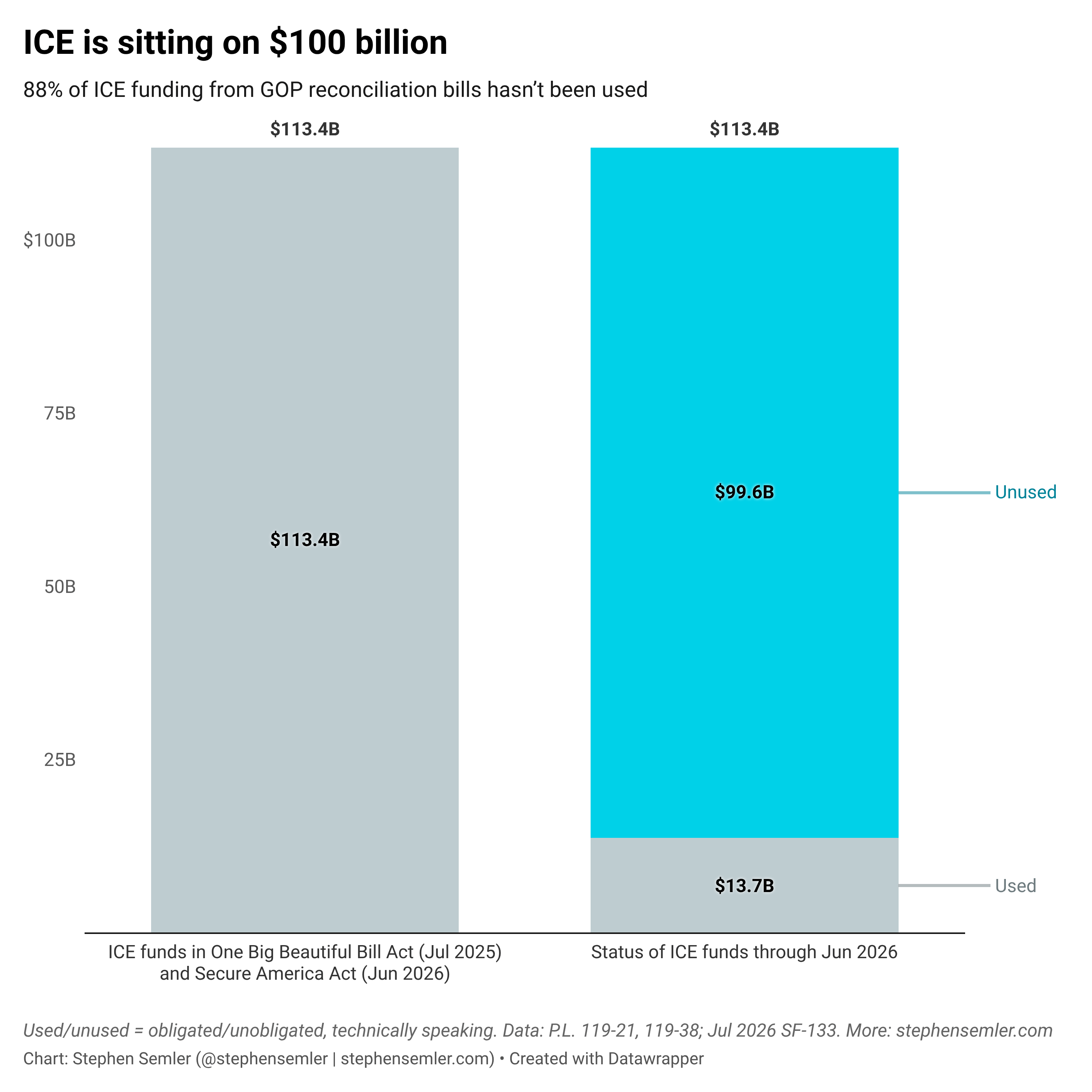
^Alt text for screen readers: ICE is sitting on $100 billion. 88% of ICE funding from GOP reconciliation bills hasn’t been used. ICE funds in One Big Beautiful Bill Act (July 2025) and Secure America Act (June 2026), $113.4 billion; status of ICE funds through June 2026, $13.7 billion used and $99.6 billion unused. Used/unused = obligated/unobligated, technically speaking. Data: P.L. 119-21, 119-38; Jul 2026 SF-133.
Methodology
Senate Budget Committee staffers found that through May 30, ICE had $62 billion in unobligated funds from the One Big Beautiful Bill Act (P.L. 119-21). The press release did not include a fully detailed methodology (why would it), but the logical steps are all there, which I adopted for this analysis of obligations through June 30. First, I searched apportionment data to find the unique Treasury Appropriations Fund Symbol (TAFS) for the ICE accounts funded by the 2025 reconciliation bill. There were two: Procurement, Construction, and Improvements (TAFS: 70-0545 2025/2029) and Operations and Support (TAFS: 70-0540 2025/2029). Second, I searched for those TAFS in the July SF 133 report for the Department of Homeland Security and referred to the line numbers showing the amount of unobligated funds. Third, I combined those sums and compared the total to the $74.9 billion in appropriated funds via P.L. 119-21.
SPECIAL THANKS TO: Abe B., Alan F., Alexander L., Alissa Q., Amin, Andrew R., AT., B. Kelly, Barbara B., Bart B., BeepBoop, Ben, Ben C.,* Bill S., Bob N., Brett S., Byron D., Carol V., Catherine L., Chris, Chris G., Claudia, Cole H., Coleman J., D. Kepler, Daniel M., Dave, David J., David S.,* David V.,* David M., Dharna N., Elizabeth R., Emily H.,* Errol S., Ethan R., Foundart, Fran Q., Francis M., Frank R., Fred R., Gary W., Gladwyn S., Graham P., Griffin R., Heath P., Hunter S., IBL, Irene B., Isaac, Isaac L., Jacob, James G., James H., James N., Jamie LR., Jcowens, Jeff, Jennifer, Jennifer J., Jessica S., Jerry S., Joe R., John, John, John A., John K., John M., Jonathan S., Joseph B., Joshua R., Julia G., Julian L., Katrina H., Keith B., Kesh L., Kheng L., Lea S., Leah A., Leila CL., Lenore B., Linda B., Linda H., Lindsay, Lindsay S.,* Lora L., Lou B., Mapraputa, Marie R., Mark L., Mark G., Marvin B., Mary Z., Marty, Matthew H.,* Megan., Melanie B., Michael S., Mitchell P., Nick B., Noah K., Norbert H., Omar A., Omar D.,* Peter M., Phil, Philip L., Ron C., Rosemary K., Sari G., Scarlet, Scott H., Silversurfer, Soh, Springseep, Stan C., TBE, Teddie G., Theresa A., Themadking, Tim C., Timbuk T., Tom B., Tony L., Tony T., Troy, Tyler M., Victor S., Viviane A., Wayne H., William H.,* William P.
* = founding member
-Stephen (Follow me on Instagram, Twitter, and Bluesky)
Caviar fascism (unless one of you can think of a better term for it).
Senate Budget Committee staffers were going to get their flowers in this newsletter anyway. As you’ll see below, I emulated their methodology from their June analysis of ICE and CBP obligations through May 30. After my May figures lined up with theirs, I proceeded to the June data in the July SF 133 report.
Through 30 June 2026 — three-quarters of the way through the fiscal year — ICE has used $13.7 billion. Obligating funds at the same rate through the rest of the fiscal year equals $18.3 billion, or 51% of the planned $35.9 billion in obligations from OBBBA (P.L. 119–21).