
1 in 10 voters want a bigger military budget, 8 in 10 senators voted for one
Polygraph | Newsletter n°329 | 19 Dec 2025

IN THIS NEWSLETTER: A day after Trump ordered a naval blockade of Venezuela, the Senate ignored voter attitudes and approved a $901 billion military bill. Campaign cash helps explain why Congress is so comfortably defying public opinion.
*See how your senators voted on the $901 billion military bill and how much they accepted from military contractors beforehand in this newsletter for Polygraph VIPs. (House version here.)
*Why I promote paid newsletters here instead of sending them to everybody directly: Paywalled emails bother me and I can’t bring myself to send them. (NB: This is admittedly a moronic business decision on my part.)
Situation
On Tuesday, Trump announced that he had ordered a naval blockade on Venezuela, an act of war, that will continue until the country gives the US “all of the oil, land, and other assets that they previously stole from us.”1 Trump is presumably alluding to the nationalization of Venezuela’s oil industry in 1976 or its renegotiation of foreign oil contracts in 2007. If so, he’s framing a loss of oil company revenue as theft and using oil companies and “us” as synonyms.
The US orchestrated regime change in Iran in 1953 in response to its oil nationalization, and toppled the government of Iraq as part of an oil-related war in 2003.2 There are no good outcomes to US regime change in Venezuela.
Venezuela has the world’s largest proven oil reserves, and Trump’s announcement made clear that the war is squarely about that. Drugs, formerly the pretext for war, were relegated to a secondary issue, a mere byproduct of the country’s oil. What had been the glaring subtext for Trump’s escalation (oil) is now the stated justification. I’m grateful for the transparency.
As of yesterday, net support for an invasion of Venezuela among US voters stands at –36% (22% support to 58% oppose, including “strongly support” at 10% and “strongly oppose” at 44%). But Trump doesn’t need public opinion on his side to wage a major war. What he really needs is reassurance that Congress is willing to fund one.
Senate approves $901 billion military bill
On Wednesday, the Senate passed the 2026 National Defense Authorization Act (NDAA), authorizing $901 billion in military spending, after the House approved it a week earlier. Because the Trump administration plans to use $119 billion of the Big Beautiful Bill’s extra $156 billion military spending next year, the NDAA’s passage signals congressional support for a $1.020 trillion military budget in 2026.3 Adjusted for inflation, the only years with larger military budgets were 2010 — when nearly 200,000 US troops, excluding contractors, were in Iraq and Afghanistan — and 1944 and 1945, during World War II.
The bill passed by a 77–20 margin. Only 10% of voters want a larger military budget, but nearly 80% of the Senate just voted for one. That’s even more out of step with public opinion than House votes on the same bill. If there were a contest over which chamber can distance itself further from voter attitudes on military spending, the Senate would be winning, albeit not by much.
As I did with the 424 House votes, I looked at the money behind the 97 Senate votes, comparing how senators voted with how much each accepted from arms industry donors last election cycle. Paid subscribers already saw the full data in an interactive table (senators are ranked by political contributions received by default, but if you sort that column from lowest to highest, you’ll suddenly see a lot more no/nay votes at the top of the table.)
The chart below compares yes/yea votes and no/nay votes on the NDAA, showing the median amount each group received from military contractors before voting on the $901 billion military bill. I’m now about to state the obvious, but in a very specific way. Money in politics matters: senators who voted to increase military spending received 3.5 times as much arms industry cash as senators opposed.
This money doesn’t predict votes, but it makes aligning congressional votes with public opinion much more difficult.
In many cases, the massive cash incentive effectively rules out the possibility of simply talking a lawmaker into supporting a lower military budget using facts and reason alone. It quite literally makes them unreasonable. Public opinion isn’t enough either — public pressure is needed, and at an amount lawmakers could reasonably describe as fearful. Enough to make the money from military contractors seem trivial.4
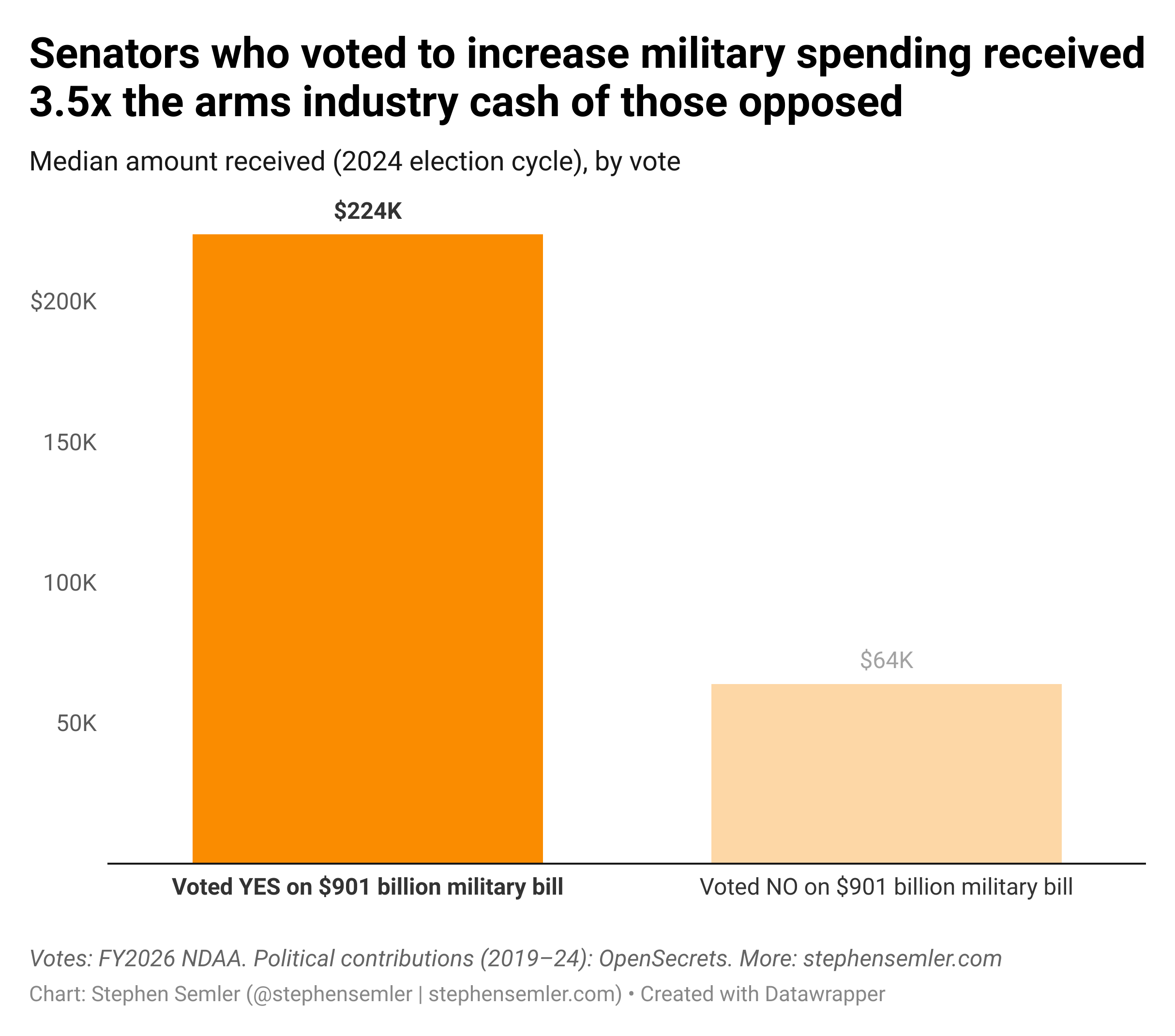
^Senators who voted to increase military spending received 3.5 times the arms industry cash of those opposed. Median amount received (2024 election cycle), by vote. Voted YES on $901 billion military bill: $224,028. Voted NO on $901 billion military bill: $63,956. Votes: Fiscal Year 2026 National Defense Authorization Act (NDAA). Political contributions (2019 to 2024): OpenSecrets.
SPECIAL THANKS TO: Abe B., Alan F., Alissa Q., Amin, Andrew R., AT., B. Kelly, Bart B., BeepBoop, Ben, Ben C.,* Bill S., Bob N., Brett S., Byron D., Carol V., Chris, Chris G., Cole H., Coleman J., D. Kepler, Daniel M., Dave, David J., David S.,* David V.,* David M., Elizabeth R., Emily H.,* Errol S., Foundart, Francis M., Frank R., Fred R., Gary W., Gladwyn S., Graham P., Griffin R., Hunter S., IBL, Irene B., Isaac, Isaac L., Jacob, James G., James H., James N., Jamie LR., Jcowens, Jeff, Jennifer, Jennifer J., Jessica S., Jerry S., Joe R., John, John, John A., John K., John M., Jonathan S., Joseph B., Joshua R., Julia G., Julian L., Katrina H., Keith B., Kheng L., Lea S., Leah A., Leila CL., Lenore B., Linda B., Linda H., Lindsay, Lindsay S.,* Lora L., Mapraputa, Marie R., Mark L., Mark G., Marvin B., Mary Z., Marty, Matthew H.,* Megan., Melanie B., Michael S., Mitchell P., Nick B., Noah K., Norbert H., Omar A., Omar D.,* Peter M., Phil, Philip L., Ron C., Rosemary K., Sari G., Scarlet, Scott H., Silversurfer, Soh, Springseep, Stan C., TBE, Teddie G., Theresa A., Themadking, Tim C., Timbuk T., Tony L., Tony T., Tyler M., Victor S., Wayne H., William H.,* William P.
* = founding member
-Stephen (Follow me on Instagram, Twitter, and Bluesky)
I don’t know what Trump is referring to by “land, and other assets” and I suspect he doesn’t either.
Scholarship on the 2003 war in Iraq is divided (actually more like diffuse) on how central oil was to the US invasion of the country.
As a policy bill, the NDAA itself does not provide funding, but it serves as a blueprint for spending bills by determining the programs eligible for funding and setting funding priorities. The total amount authorized by the NDAA typically aligns very closely with the amount appropriated by spending legislation, so votes on the NDAA credibly indicate support or opposition to a proposed military budget. Also, the $1.020 trillion figure refers only to the military spending authorized in the NDAA, meaning it excludes military-related costs like funding for Veterans Affairs.
These political contributions have more subtle effects, too. Because it’s much easier to get meetings with a Hill office after you’ve donated to the person whose name is next to the office door, arms industry perspectives have greater purchase on policy decisions than they otherwise would.