
Congress ignores public opinion, approves $901 billion military bill
Polygraph | Newsletter n°327 | 12 Dec 2025

IN THIS NEWSLETTER: Wednesday’s votes on the $901 billion military policy bill clash with public opinion, so I looked at the money behind House members’ votes.
*See how your representative voted on the $901 billion military policy bill and how much they received beforehand from military contractors in the latest newsletter for Polygraph VIPs.
*Thank you, Fred R., for becoming a Polygraph VIP! Please consider joining Fred and the other paid subscribers thanked at the bottom of each newsletter to support my work.
Situation
The House passed the 2026 National Defense Authorization Act (NDAA) on Wednesday, which authorizes $901 billion in military spending — $8 billion more than Trump asked for. An additional $156 billion was included in the Big Beautiful Bill, so the NDAA’s passage signals congressional support not only for its many ugly provisions, but also for a $1 trillion-plus military budget next year.
Historic increases in military spending like the one authorized by the NDAA enable Trump’s foreign policy and practically define his domestic agenda. Money is policy. If you oppose war with Venezuela, occupations of US cities, or a historic transfer of public wealth to private companies partly paid for by cuts to social programs, you vote against the NDAA. If you’re fine with or get excited about those things, you vote for the bill.
I recommended that members of Congress oppose the bill. Only a quarter of them did: the bill passed by a 312–112 margin.1
1. Increasing military spending: Public opinion vs. House votes
If congressional votes reflected public opinion, the bill wouldn’t have passed. Only 1 in 10 voters want a bigger military budget, but more than 7 in 10 House members voted for one on Wednesday.
The discrepancy is illustrated in the following graph. Each pair of bars compares public opinion on military spending and House votes on the same issue. The percentages are the share of voters who support increasing military spending and the share of House members who voted to authorize one through the NDAA.
Feel free to comment below on which party you find more annoying in this context. On one hand, Republicans overwhelmingly voted for the NDAA, and are further out of step with the views of their base than their House counterparts. On the other hand, the bill wouldn’t have passed without the support of Democrats, who just handed a trillion-dollar military budget to a guy they’ve called authoritarian for the past decade.
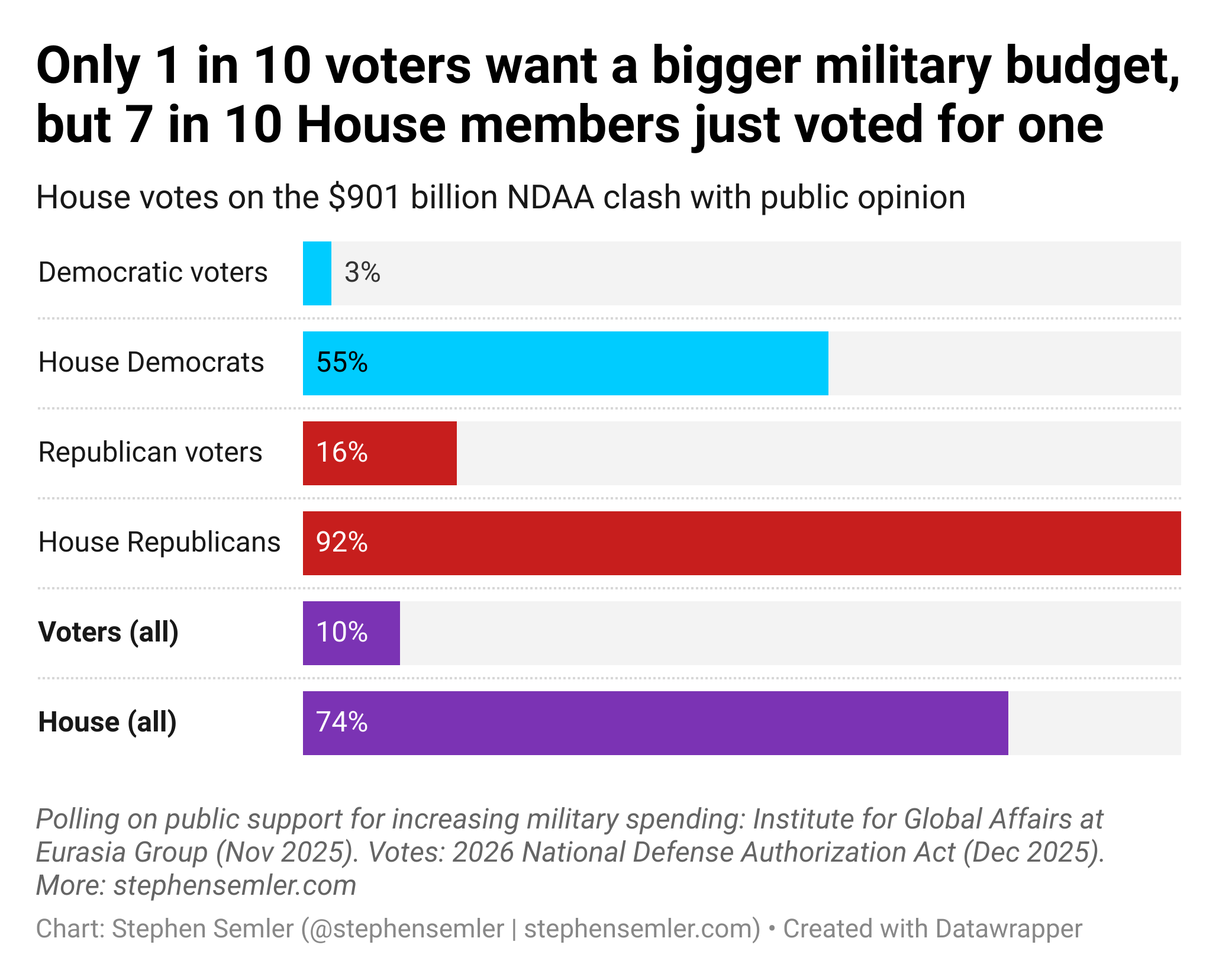
^Alt text for screen readers: Only 1 in 10 voters want a bigger military budget, but 7 in 10 House members just voted for one. House votes on the $901 billion NDAA clash with public opinion. Support for increasing military spending among Democratic voters: 3%. House Democrats: 55%. Republican voters: 16%. House Republicans: 92%. Voters (all): 10%. House (all): 74%. Polling on public support for increasing military spending: Institute for Global Affairs at Eurasia Group (Nov 2025). Votes: 2026 National Defense Authorization Act (Dec 2025).
2. Cash4Votes
I looked at the money behind the 424 House votes on the NDAA. Specifically, I compared how each House member voted with the amount they accepted from arms industry donors last election cycle (2023–24).2 I sent the data to paid subscribers in an interactive table, where they can sort by name, party, vote, and arms industry cash received. (Recommendation: in the political donations column, go back and forth between sorting amounts from lowest to highest and highest to lowest while keeping your eye on the vote column. It’s wild.)
On average, members who voted to authorize $901 billion in military spending received four times as much money from military contractors as those opposed. (This four-to-one ratio between yes and no votes holds whether you take the mean or median for each group. The chart below refers to the mean.)
I can’t imagine you’re surprised by the results. I’m not surprised, either: I’ve run this analysis since 2018 and found the same correlation — politicians voting to increase military spending taking more money from military contractors — every single year.
Considering the share of military contractors’ revenue from the US government, much of the money they give members of Congress originally came from taxpayers. Arms companies are recycling funds back to the people who signed off on that funding in the first place, helping ensure that Congress doesn’t represent public opinion on how federal dollars should be allocated. Military spending doesn’t just buy weapons, it buys a way of life.
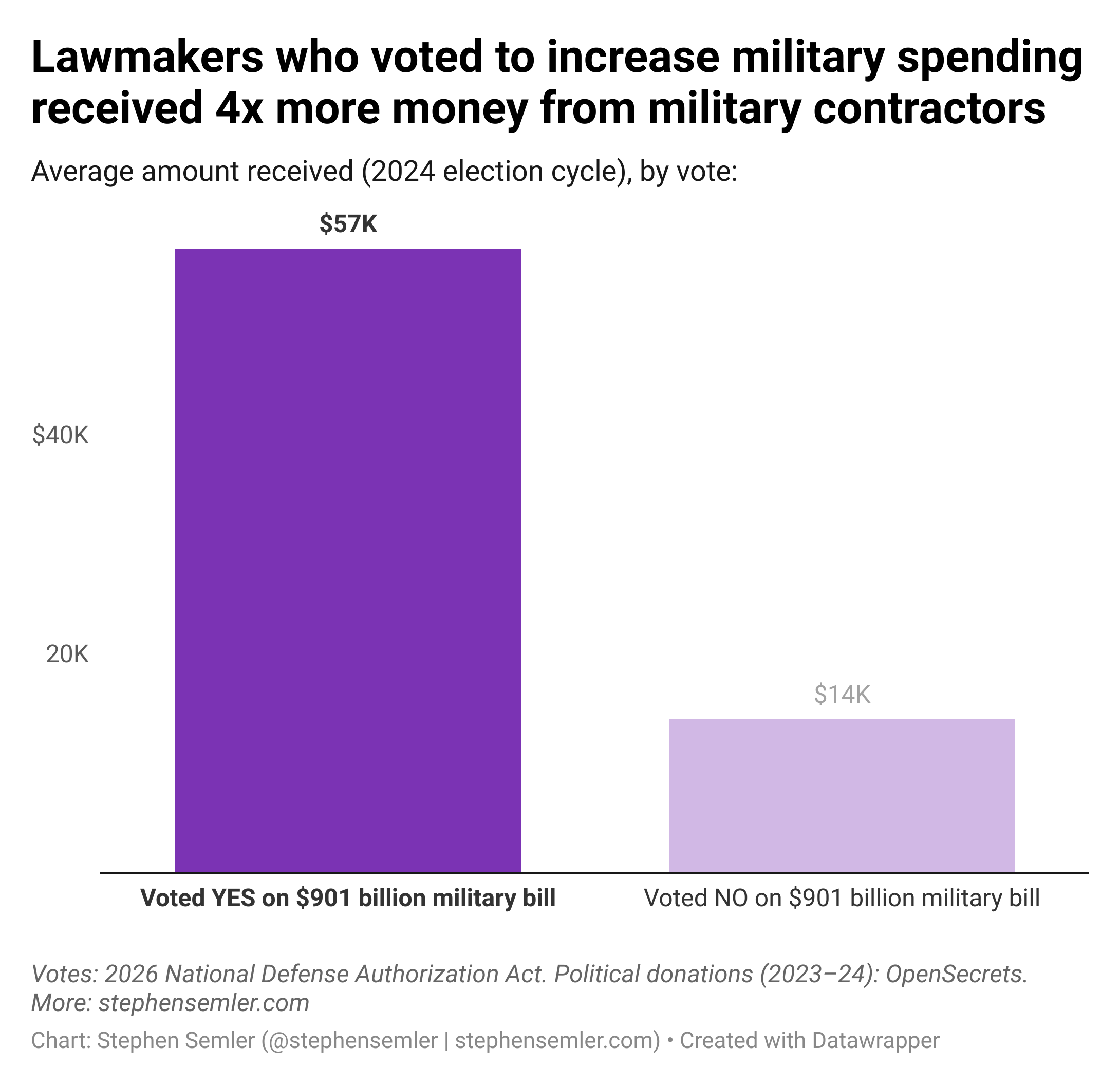
^Alt text for screen readers: Lawmakers who voted to increase military spending received 4 times more money from military contractors. Average amount received (2024 election cycle), by vote. Voted YES on $901 billion military bill: $57,000. Voted NO on $901 billion military bill: $14,000. Votes: 2026 National Defense Authorization Act. Political donations (2023–24): OpenSecrets.
SPECIAL THANKS TO: Abe B., Alan F., Alissa Q., Amin, Andrew R., AT., B. Kelly, BartB., BeepBoop, Ben, Ben C.,* Bill S., Bob N., Brett S., Byron D., Carol V., Chris, Chris G., Cole H., Coleman J., D. Kepler, Daniel M., Dave, David J., David S.,* David V.,* David M., Elizabeth R., Emily H.,* Errol S., Foundart, Francis M., Frank R., Fred R., Gary W., Gladwyn S., Graham P., Griffin R., Hunter S., IBL, Irene B., Isaac, Isaac L., Jacob, James G., James H., James N., Jamie LR., Jcowens, Jeff, Jennifer, Jennifer J., Jessica S., Jerry S., Joe R., John, John, John A., John K., John M., Jonathan S., Joseph B., Joshua R., Julia G., Julian L., Katrina H., Keith B., Kheng L., Lea S., Leah A., Leila CL., Lenore B., Linda B., Linda H., Lindsay, Lindsay S.,* Lora L., Mapraputa, Marie R., Mark L., Mark G., Marvin B., Mary Z., Marty, Matthew H.,* Megan., Melanie B., Michael S., Mitchell P., Nick B., Noah K., Norbert H., Omar A., Omar D.,* Peter M., Phil, Philip L., Ron C., Rosemary K., Sari G., Scarlet, Scott H., Silversurfer, Soh, Springseep, Stan C., TBE, Teddie G., Theresa A., Themadking, Tim C., Timbuk T., Tony L., Tony T., Tyler M., Victor S., Wayne H., William H.,* William P.
* = founding member
-Stephen (Follow me on Instagram, Twitter, and Bluesky)
This is the link to the correct roll call, despite the unrelated bill title and number at the top of the webpage. This is due to a procedural quirk. Congress sometimes takes an existing bill (in this case, S.1071) and substitutes its text with unrelated language (in this case, the conference/final version of the 2026 NDAA). The former retains its title, but serves as a shell for the latter. This is done for the sake of speed — for members of Congress, doing this procedural sleight of hand is quicker than introducing a whole ‘nother bill. It’s confusing for pretty much everyone else, including your boy.
I won’t say how long this research took, but I will say that by the end of it I was basically fused to my chair like the pilot of the derelict spaceship in Alien, minus the chest wound and the symbolism apparent in H.R. Giger’s work that I’m not going to discuss here.