
Democratic leaders offer ICE reforms — and record funding
Polygraph | Newsletter n°335 | 9 Feb 2026

IN THIS NEWSLETTER: After a string of ICE murders, Democratic leaders propose reforms — and $11 billion in additional ICE funding.
*Thank you, Alexander L. and Kesh L., for becoming paid subscribers! Please consider joining Alexander, Kesh, and the other VIPs thanked at the bottom of each note to support my work.
*Latest newsletter for VIPs: Israel doesn’t fund the vast majority of its US weapons purchases — US taxpayers do. Here’s precisely how much Americans pay for arms “sales” to Israel. Read more.
*Read my comments on US military aid to Israel in L’Orient–Le Jour.
Situation
The House ended the partial government shutdown last week by passing legislation containing five full-year spending bills for 2026 — Pentagon ($839 billion); Labor, Health and Human Services, and Education ($195 billion); Transportation and Housing and Urban Development ($103 billion); Financial Services and General Government ($26 billion); State Department ($50 billion) — and a temporary funding extension for the Department of Homeland Security (prorated based on its $89 billion 2025 budget).
The spending package originally contained a full-year Department of Homeland Security (DHS) funding bill, but the Senate replaced it with a two-week funding measure after Customs and Border Protection (CBP) agents murdered legal observer Alex Pretti, RN, which followed the murder of Renee Good by Immigration and Customs Enforcement (ICE) agents.1 The Senate approved the amended legislation on January 30, sending it back to the House.2 Democratic leaders said they would use those two weeks to negotiate ICE reforms as a condition for approving the full-year DHS funding bill.
Assessing Democratic leadership’s proposed ICE reforms
On Wednesday, House and Senate Minority Leaders Hakeem Jeffries (D-NY) and Chuck Schumer (D-NY) proposed ten reforms for ICE, which you can read here. None of them involve reducing ICE funding.
The question isn’t whether these proposed reforms are any good. The question is whether they’re worth $11 billion. Why? Because there’s $11 billion for ICE in the pending 2026 DHS bill, and agreeing to the reforms unlocks the Democratic votes needed to pass it.
If you’re ICE, it’s an easy choice: take the money. First let Jeffries and Schumer concede some of their ten demands, then ignore the rest once the DHS bill passes. You’ll eventually get a strongly worded letter from Jeffries and Schumer for disregarding the agreed-upon reforms, but it’s not like your livelihood (budget) will be in danger. If Democratic leaders won’t try to cut ICE’s funding after it murders someone, they’re not going to block funding over masks and military apparel.
Trump administration goals — including deporting 1 million people per year and producing media content that shows the use of overwhelming force against immigrants — require ICE to function as a paramilitary force and occupy major metropolitan areas. Based on their proposal, Jeffries and Schumer are saying they can stop ICE’s warrantless arrests, arbitrary detention, and summary executions without ending its occupation of US cities, even though those illegal actions are part and parcel of military occupations. Money is policy: you can’t give ICE a budget larger than all but 15 militaries worldwide and expect the agency to demilitarize its behavior. Jeffries and Schumer know this.
The limits of Democratic opposition to state violence
The Jeffries–Schumer proposal speaks to a broader theme: Even when Democrats object to state violence, they’re still willing to fund it. This applies to both paramilitary (ICE) and military spending.
On January 29, Sen. Tim Kaine (D-VA) introduced a war powers resolution prohibiting US forces from attacking Iran without congressional approval. A smart move, considering recent reports warning of an imminent US attack and Trump himself setting the precedent for the US bombing Iran — something of a red line for past administrations — in June. This time around, the goal appears to be regime change.
The next day, Kaine voted to hand Trump a record military budget. The $839 billion Pentagon funding bill, when combined with the military spending in the reconciliation bill and other 2026 funding bills,3 totals $1.02 trillion.
Within 48 hours, Kaine objected to a unilateral war with Iran and approved the funding needed to fight one. He’s willing to take action reasserting Congress’ warmaking powers, but checking executive overreach using Congress’ power of the purse is apparently too much to ask.
Kaine’s position represents the extent to which the Democratic leaders want the party to be anti-war. For party leadership, it’s OK to be pro-war and it’s OK to introduce non-binding resolutions against war, but funding war is non-negotiable. Increasing military spending is acceptable if not encouraged; cutting it is anathema.
To illustrate this point, when the GOP reconciliation bill was being considered in the House last summer, Democratic leadership discouraged its members from proposing amendments striking the bill’s more than $150 billion in military spending. (I heard this directly from Hill staff.) Keep in mind that most amendments Democrats submitted to the Big Beautiful Bill weren’t given a vote; they were symbolic. But House Democratic leaders didn’t even want to give the faintest suggestion that the party opposed a massive increase in military spending.4
Democratic leadership has apparently decided that the party will not constrain war abroad or at home by reducing military or paramilitary spending, regardless of who’s president.
Reining in the US paramilitary budget
An alternative to the Jeffries–Schumer ICE proposal: Refuse to pass a DHS bill with ICE funding.
Some argue that such a demand would be pointless because ICE already has funding from the GOP reconciliation bill ($19 billion annually over the next four years, on average). Republicans, they say, would scoff at Democrats’ demand, let temporary DHS funding lapse, and allow other DHS agencies to shut down indefinitely. Democrats’ hands are tied.
I don’t find this argument convincing. First, I don’t think the GOP would be fine leaving the rest of DHS unfunded. Take FEMA, for example. How long would congressional Republicans be willing to deny a Republican administration the ability to respond to hurricanes, floods, and the like over extra ICE funding? Or take TSA — how much patience does the Trump administration have for an extended airport security staffing shortage? Republicans’ hands are tied.
Second, the fact that ICE already has funding is not an excuse to give them more. The $11 billion in the pending DHS bill would be on top of the projected $19 billion from the reconciliation bill for 2026.5 Giving ICE that extra $11 billion would nearly triple its 2025 budget, which was already a record high.
The table below ranks the pending $30 billion ICE budget among the highest funded militaries. It comes in at 16th, exceeding the military spending of countries like Canada, Spain, Brazil, Mexico, Sweden, Iran, and Switzerland. (Combined funding for ICE and the adjacent CBP stands at $66 billion, which would rank 8th.)
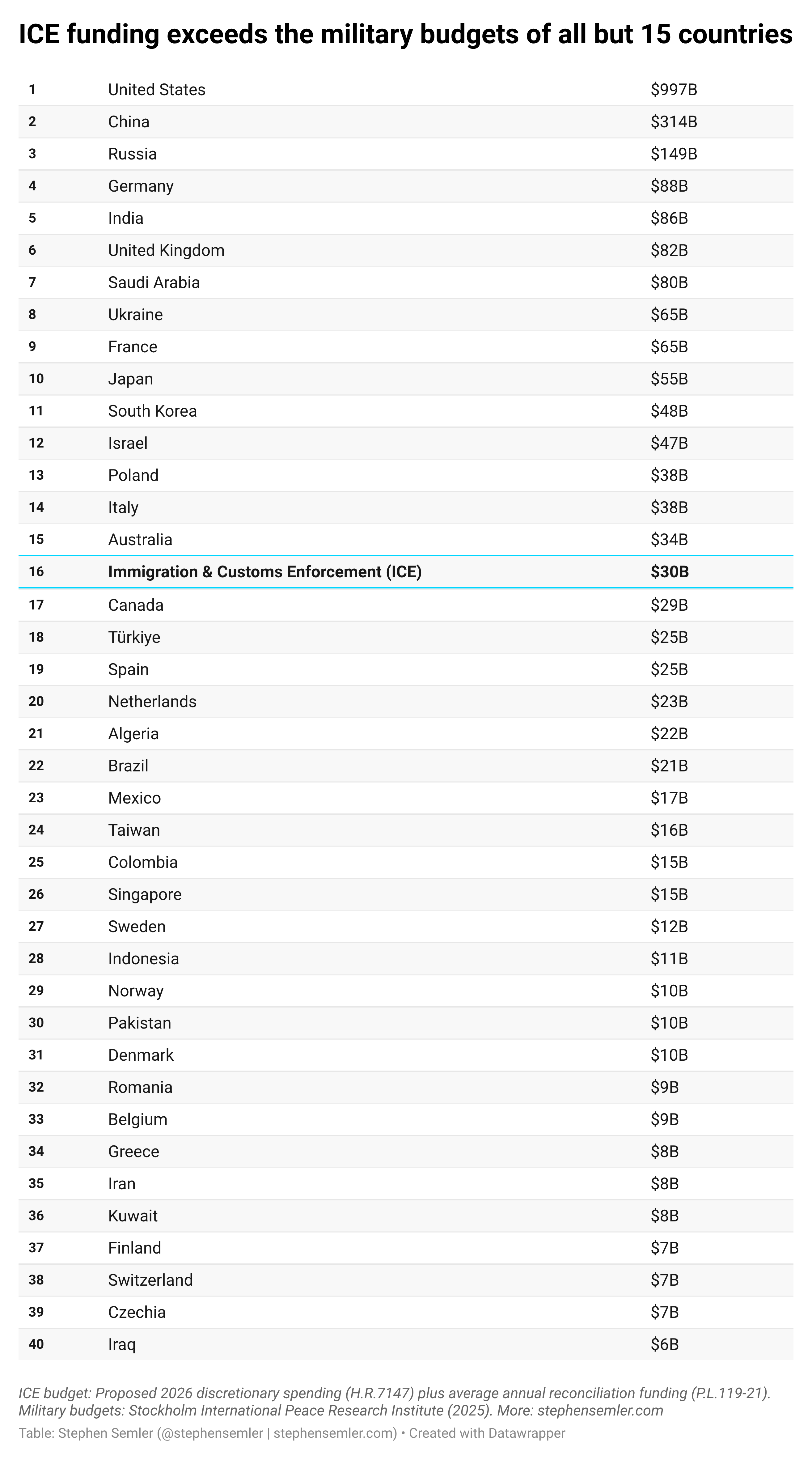
^Alt text for screen readers: ICE funding exceeds the military budgets of all but 15 countries. This table ranks the proposed $30 billion ICE budget for 2026 among the largest military budgets worldwide. It has 3 columns — ranking, military or agency, and funding — and 40 rows, 39 of which are country military budgets and 1 is the ICE budget. ICE is ranked 16th, larger than the military budgets of countries including Canada, Spain, Brazil, Mexico, Sweden, Iran, and Switzerland. The ICE budget refers to the proposed 2026 discretionary spending in H.R.7147 plus average annual reconciliation funding in P.L.119-21. Military budgets are sourced from the Stockholm International Peace Research Institute.
SPECIAL THANKS TO: Abe B., Alan F., Alexander L., Alissa Q., Amin, Andrew R., AT., B. Kelly, Bart B., BeepBoop, Ben, Ben C.,* Bill S., Bob N., Brett S., Byron D., Carol V., Catherine L., Chris, Chris G., Claudia, Cole H., Coleman J., D. Kepler, Daniel M., Dave, David J., David S.,* David V.,* David M., Dharna N., Elizabeth R., Emily H.,* Errol S., Foundart, Francis M., Frank R., Fred R., Gary W., Gladwyn S., Graham P., Griffin R., Hunter S., IBL, Irene B., Isaac, Isaac L., Jacob, James G., James H., James N., Jamie LR., Jcowens, Jeff, Jennifer, Jennifer J., Jessica S., Jerry S., Joe R., John, John, John A., John K., John M., Jonathan S., Joseph B., Joshua R., Julia G., Julian L., Katrina H., Keith B., Kesh L., Kheng L., Lea S., Leah A., Leila CL., Lenore B., Linda B., Linda H., Lindsay, Lindsay S.,* Lora L., Mapraputa, Marie R., Mark L., Mark G., Marvin B., Mary Z., Marty, Matthew H.,* Megan., Melanie B., Michael S., Mitchell P., Nick B., Noah K., Norbert H., Omar A., Omar D.,* Peter M., Phil, Philip L., Ron C., Rosemary K., Sari G., Scarlet, Scott H., Silversurfer, Soh, Springseep, Stan C., TBE, Teddie G., Theresa A., Themadking, Tim C., Timbuk T., Tony L., Tony T., Tyler M., Victor S., Wayne H., William H.,* William P.
* = founding member
-Stephen (Follow me on Instagram, Twitter, and Bluesky)
The original version of this piece mistakenly attributed Pretti’s murder to ICE agents, when it was actually committed by CBP agents.
The House had already passed all five bills plus the full-year funding bill for DHS last month, but had to vote on them again (sans full-year DHS bill), this time as a single package, because the Senate considered the six bills as a single piece of legislation and amended it with the two-week DHS continuing resolution.
Specifically, $34 billion from the Energy Department bill (mostly for nuclear weapons); $20 billion from Military Construction and Veterans Affairs; $7 billion from Commerce, Justice, and Science; $3 billion (pending) from Homeland Security; $400 million from Transportation and HUD; and $50 million from Financial Services.
I heard from a trusted acquaintance that, per their conversations on the Hill, Democratic leadership issued a similar instruction regarding stripping the DHS/ICE funding in the Big Beautiful Bill.
The Big Beautiful Bill’s $75 billion in supplemental ICE funding spread out evenly over four years averages out to $19 billion annually. This methodology for estimating 2026 ICE reconciliation spending has been adopted by Polygraph, Congressional Research Service, and others.
Thank you for this, especially the helpful chart showing the outrageously overblown US spending on the military and ICE. As for the Democratic hypocrisy when it comes to raising the alarm about Trump but dutifully approving funding for all his wars--both domestic and foreign--I've come to accept this as the Party's complete surrender to the Pro-War and Pro-Genocide foreign policy wing of our empire.
I'm old enough to remember when many Democrats were unafraid to criticize America's war mongering, even when the war was carried out by a Democratic president. As James Carden has written:
"The Vietnam era marked perhaps the high point of progressive dissent against the American war machine. The anti-war movement was certainly well represented (especially by today’s standards) in the US Senate, where J William Fulbright, William Proxmire, Wayne Morse, Robert F Kennedy, George McGovern, Eugene McCarthy and Frank Church opposed president Lyndon B. Johnson’s war."
The Democratic Party has long since abandoned its former working class base and become just another tool of the corporate oligarchs that now direct its policy preferences. Any statements or proposals made by Democrats that purport to oppose these policies are purely theatrical.