
Iran War: Most unpopular US war in history
Polygraph | Newsletter n°344 | 22 Jun 2026

IN THIS NEWSLETTER: Trump readies the invoice for the most unpopular US war in history.
*Listen to my interview with Fran Quigley: How the Arms Industry is Robbing the Working Class of a Better Life
War costs
The Trump administration is about to send Americans the bill for a war they never wanted.
The Wall Street Journal reported on Friday that Pentagon leaders told lawmakers the department needs about $80 billion to recoup its Iran War expenses. The administration is expected to send a formal war funding request to Congress this week. The funding would be on top of the $1.1 trillion military budget Congress approved earlier this year.
America’s most unpopular war
“I believe we do have the support of the American people.” — Pentagon chief Pete Hegseth on public support for the Iran War, April 30, 2026
The Iran War is now the most unpopular US war in history.
When I compared public opinion on the Iran War to past major US conflicts in May, the ongoing war hadn’t quite reached Vietnam’s level of unpopularity. But polling from June shows that the Iran War has now sunk to –32% net support — below the –31% recorded in the final poll during the Vietnam War. (Net support = % support minus % opposed.)
That alone doesn’t fully capture how historically unpopular the Iran War is. Based on my analysis of 153 public opinion surveys across 7 major US conflicts, the Iran War is the most unpopular US war in history in at least three ways:
The Iran War started with lower public support than any other US war. At –13%, it’s the first — and only — war to begin with negative net support.
The Iran War currently has lower public support than any other US war. At –32%, it trails the Vietnam War’s ending net support.
At no point have more Americans supported the Iran War than opposed it. In terms of net support, it’s the first US war to be fought entirely under water.
The first graph below covers the first two findings, while the second covers the third.1 Polling for each war includes the first survey after the war started, the last survey before the war ended, and (for the second graph) all the surveys conducted in between. The methodology section is under the graphs.
Data for the past six wars came from Gallup, which for reasons unknown, decided not to consistently poll this war. For the Iran War, I used data from Economist/YouGov, which has produced the best surveys on the war in terms of frequency, question wording, and continuity with the historical data.2
Gallup asked respondents whether they thought a given war was or was not a mistake;3 Economist/YouGov polls asked whether respondents support or oppose the war.4 Both question formats can yield more forgiving readings of war support than actually exist. Compare, for example, the responses to two Economist/YouGov questions asked this month:
Do you support or oppose the war with Iran?
All respondents:
Support: 28%
Oppose: 60%
Republican respondents only:
Support: 67%
Oppose: 20%
Do you think we should make a deal to end the war in Iran as quickly as possible?
All respondents:
Yes: 65%
No: 13%
Republican respondents only:
Yes: 54%
No: 26%
Among Republicans, support for the Iran War is at 47% (per the first question), but support for prolonging the war — not ending it as soon as possible through diplomacy — is at –28% (per the second). A significant portion of the US adult population is effectively saying, “Yes, I support fighting this war; yes, I want to stop fighting it ASAP.”
Among all Americans, net support for prolonging the Iran War — as opposed to ending it ASAP — stands at –52%.
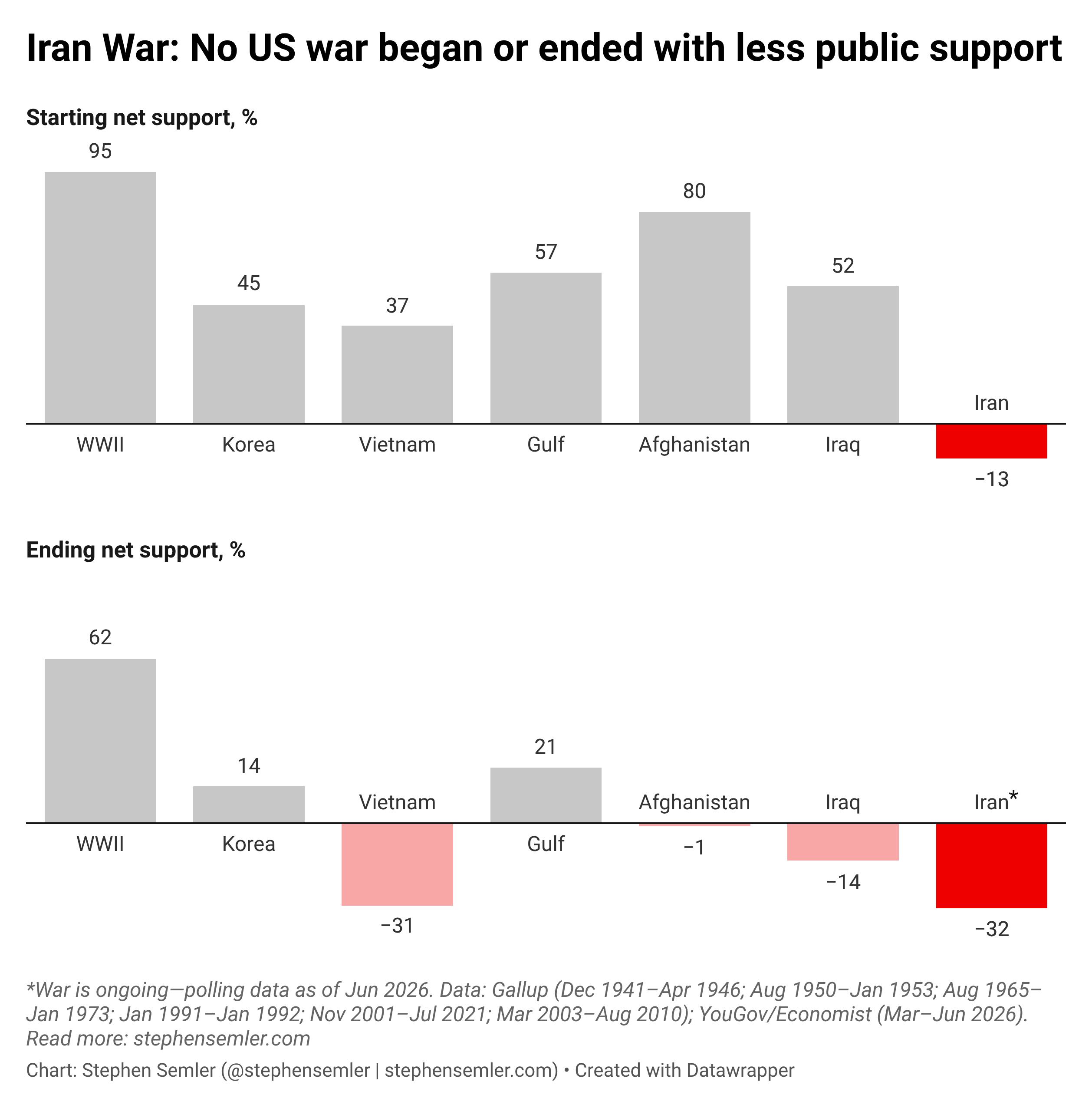
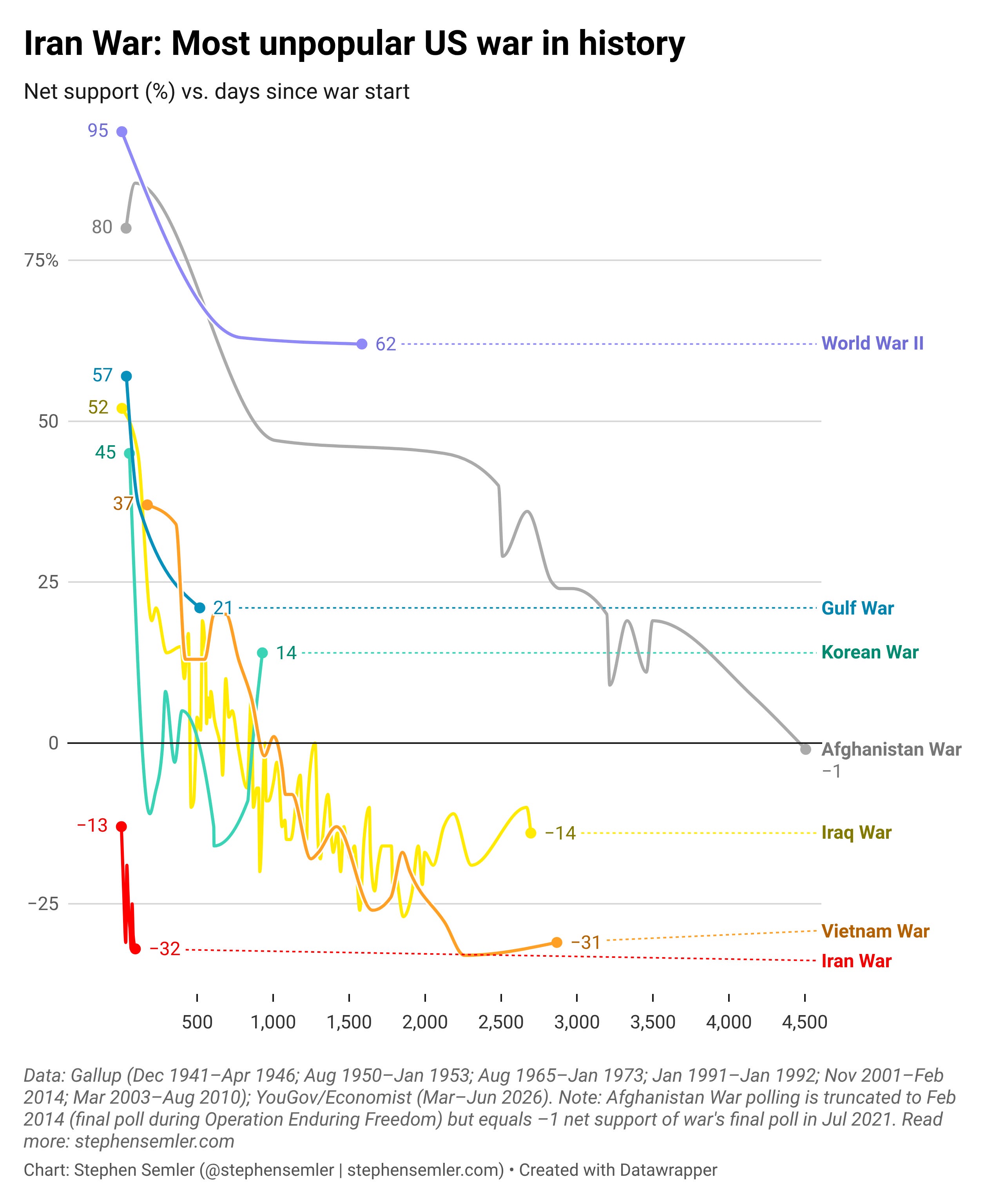
^Alt text for screen readers: Top chart: Iran War: No US war began or ended with less public support. The image shows two column charts stacked on top of each other. This chart shows two column graphs stacked on top of one another: the first shows the starting net support for the last seven U.S. wars; the bottom chart shows the ending (or in the Iran War’s case, latest net support) during each war. Here is each war with its starting and ending (or latest) net support: World War II, 95%, 62%; Korea, 45%, 14%; Vietnam, 37%, –31%; Gulf, 57%, 21%; Afghanistan, 80%, –1%; Iraq, 52%, –14%; Iran, –13%, –32%. Iran War data is through 79 days. Polling data: Gallup (Dec 1941–Apr 1946; Aug 1950–Jan 1953; Aug 1965–Jan 1973; Jan 1991–Jan 1992; Nov 2001–Jul 2021; Mar 2003–Aug 2010); Economist/YouGov (Mar–Jun 2026). Bottom chart: Iran War: Most unpopular US war in history. The image shows the trajectories in popularity of the last seven U.S. wars. Here is each war with its starting and latest net support: World War II, 95%, 62%; Korea, 45%, 14%; Vietnam, 37%, –31%; Gulf, 57%, 21%; Afghanistan, 80%, –1%; Iraq, 52%, –14%; Iran, –13%, –30%. Iran War data is through 79 days. Data: Gallup (Dec 1941–Apr 1946; Aug 1950–Jan 1953; Aug 1965–Jan 1973; Jan 1991–Jan 1992; Nov 2001–Jul 2021; Mar 2003–Aug 2010); Economist/YouGov (Mar–Jun 2026).
Methodology
Polling for each war includes the first survey after the war starts, the last survey before the war ends, and all surveys conducted in between. In other words, net support (= % who support the war – % opposed to the war) for wars that had yet to begin are not included; neither is net support for wars that had already concluded. For example, the most recent Gallup poll on the Afghanistan War shows –4% net support, but that poll was conducted in August 2022, a year after the war ended; hence, it isn’t included in this study. The final poll on the war before it ended took place in July 2021, showing –1% net support.
For war start and end dates, I defaulted to the federally designated “periods of war” outlined in Code of Federal Regulations, Title 38, Part 3, Section 3.2. I amended these dates in a few cases. For example, the official start date for the Gulf War is August 2, 1990, marking Iraq’s invasion of Kuwait. However, the Gallup poll asked whether the US made a mistake in deploying troops in response, which didn’t happen until August 7. There are no reliable polling data for US wars before WWII.
Here’s a war-by-war breakdown:
World War II (December 7, 1941 – December 31, 1946)
Start – end: December 7, 1941 – December 31, 1946
Start – end for polling data: December 12, 1941 – April 10, 1946
Two days after the US declared war on Japan (Dec 8, 1941 — which I adopted as the start of the conflict for this study), a Gallup/American Institute of Public Opinion (AIPO) poll asked Should President Roosevelt have asked Congress to declare war on Germany, as well as on Japan? Results: 90% yes, 7% no (+83 net support). Germany declared war on the US the next day (Dec 11, 1941). Four days after the US declared war on Japan (Dec 12, 1941), Gallup/AIPO asked Do you approve, or disapprove of Congress declaring war against Japan? Results: 97% approve, 2% disapprove (+95% net approval). I chose the latter as the polling start date, because the question referred to a real declaration of war, not a hypothetical one. I suspect net support for war with Germany would have been higher had the poll been taken when the Japan poll was.
Polling data is sparse for this conflict. Only two other polls were taken before the end of the “period of war”: Do you think you, yourself, will feel it was a mistake for us to have entered this war? (Feb 2, 1944: 77% no, 14% yes) and Do you think it was a mistake for the United States to enter World War II? (Apr 10, 1946: 77% no, 15% yes). The latter was chosen as the polling data end date. However, I see why one could choose the former, hence why I provided the question and data.
Korean War (June 27, 1950 – January 31, 1955)
Start – end: June 27, 1950 – January 31, 1955
Start – end for polling data: August 20, 1950 – January 11, 1953
The first poll (asking Do you think the US made a mistake in (deciding to defend) going into war in Korea, or not?) was taken 54 days into the conflict; the final poll was conducted after 929 days (Jan 11, 1953).
Vietnam War (November 1, 1955 – May 7, 1975)
Start – end: November 1, 1955 – May 7, 1975
Start – end for polling data: August 27, 1965 – January 12, 1973
I chose as the start date when the first regular US combat troops arrived in Da Nang, Vietnam (Mar 8, 1965) to reflect the recurring poll question that started in August of that year (In view of the developments since we entered the fighting in Vietnam, do you think the U.S. made a mistake sending troops to fight in Vietnam?)
The first poll was 172 days into the conflict (Aug 27, 1965) and the final poll before the end of the war was after 2,867 days (Jan 12, 1973).
Persian Gulf War (August 2, 1990 – April 6, 1991)
Start – end: August 2, 1990 – April 6, 1991
Start – end for polling data: September 10, 1990 – January 6, 1992
Polling data is scarce for this conflict. The first and second surveys (Sep 10 and Nov 29, 1990) asked, Do you think the US made a mistake in…sending troops to Saudi Arabia or not? For that reason, I adopted August 7, 1990 — when the US began deploying military assets and personnel to Saudi Arabia and the broader Middle East in response to the Iraqi invasion of Kuwait five days earlier — as the start of the conflict.
The third Gallup poll, which was conducted nine months after the end of the war (Jan 6, 1992), asked, Thinking back to the Persian Gulf War in 1990 and 1991, all in all, do you think the situation in the Persian Gulf region was worth going to war over or not? The reason I chose the third survey as the polling end point — despite data collection happening after the end of the war — is that prior surveys were conducted before Operation Desert Storm (Jan 17, 1991), the second part of the Gulf War, following Operation Desert Shield.
Afghanistan War (October 7, 2001 – August 30, 2021)
Start – end: October 7, 2001 – August 30, 2021
Start – end for polling data: November 8, 2001 – July 6, 2021
There’s a slight variation in language from the original recurring poll question that began in 2001 (Thinking now about U.S. military action in Afghanistan that began in October 2001, do you think the United States made a mistake in sending military forces to Afghanistan, or not?) and the one that replaced it from 2013 onward (Looking back, do you think the United States made a mistake sending troops to fight in Afghanistan, or not?). The final poll used in this study (Jul 6, 2021) showed –1% net support (46% said the war wasn’t a mistake; 47% said it was).
Note on the line chart that the Afghanistan War is truncated to February 2014 in an effort to make more legible the nest of lines on the left side of the chart. The ending value is the same as July 2021 (–1%). The truncated version works anyway if you wanted to isolate the combat-centric portion of the war from the train-and-equip-centric portion. Obama declared an end of the combat mission in Afghanistan (“Operation Enduring Freedom”) in December 2014, transitioning to a much smaller force presence and a new mission (“Operation Freedom’s Sentinel”) centered on building up Afghan military and police forces. (Obama: “to preserve the gains we have made together, the United States…will maintain a limited military presence in Afghanistan to train, advise and assist Afghan forces and to conduct counterterrorism operations against the remnants of al Qaeda.”
Iraq War (March 19, 2003 – December 15, 2011)
Start – end: March 19, 2003 – December 15, 2011
Start – end for polling data: March 24, 2003 – August 5, 2010
After Obama announced the end of the US combat mission in Iraq (Aug 31, 2010), polling became much less frequent. The final polling date per this study’s methodology was 497 days before the declared end of the invasion on December 15, 2011. The final poll (Aug 5, 2010) registered –14% net support (41% said the war was not a mistake; 55% said it was).
Iran War (February 28, 2026 – ongoing)
Start – end: February 28, 2026 – Ongoing
Start – end for polling data: March 2, 2026 – June 1, 2026
Data collection for the first poll began a day before the war started, so the survey question was for some respondents a hypothetical (Would you support or oppose the U.S. using military force to overthrow the government of Iran?). For the ten polls since then, the question has been Do you support or oppose the war with Iran? Given that regime change by military force was reportedly the plan, I don’t have an issue with this slight variation in the survey question.
Per the most recent poll (June 1), net support for the war stands at –32% (28% support, 60% oppose). Other recent polls show higher net support (e.g., Ipsos, –27%) while some lower net support (e.g., New York Times/Siena, –34%), but all show a foreign policy disaster. Based on nine surveys from May 11 – May 18, the median net support for the Iran War is –26%.
SPECIAL THANKS TO: Abe B., Alan F., Alexander L., Alissa Q., Amin, Andrew R., AT., B. Kelly, Barbara B., Bart B., BeepBoop, Ben, Ben C.,* Bill S., Bob N., Brett S., Byron D., Carol V., Catherine L., Chris, Chris G., Claudia, Cole H., Coleman J., D. Kepler, Daniel M., Dave, David J., David S.,* David V.,* David M., Dharna N., Elizabeth R., Emily H.,* Errol S., Ethan R., Foundart, Fran Q., Francis M., Frank R., Fred R., Gary W., Gladwyn S., Graham P., Griffin R., Heath P., Hunter S., IBL, Irene B., Isaac, Isaac L., Jacob, James G., James H., James N., Jamie LR., Jcowens, Jeff, Jennifer, Jennifer J., Jessica S., Jerry S., Joe R., John, John, John A., John K., John M., Jonathan S., Joseph B., Joshua R., Julia G., Julian L., Katrina H., Keith B., Kesh L., Kheng L., Lea S., Leah A., Leila CL., Lenore B., Linda B., Linda H., Lindsay, Lindsay S.,* Lora L., Lou B., Mapraputa, Marie R., Mark L., Mark G., Marvin B., Mary Z., Marty, Matthew H.,* Megan., Melanie B., Michael S., Mitchell P., Nick B., Noah K., Norbert H., Omar A., Omar D.,* Peter M., Phil, Philip L., Ron C., Rosemary K., Sari G., Scarlet, Scott H., Silversurfer, Soh, Springseep, Stan C., TBE, Teddie G., Theresa A., Themadking, Tim C., Timbuk T., Tom B., Tony L., Tony T., Troy, Tyler M., Victor S., Viviane A., Wayne H., William H.,* William P.
* = founding member
-Stephen (Follow me on Instagram, Twitter, and Bluesky)
Ending net support refers to the final poll conducted during each war, or in the Iran War’s case, the most recent one. Starting net support refers to the first poll during each war. See methodology section below.
Economist/YouGov’s June 1 survey is the 11th asking “Do you support or oppose the war with Iran?”, which aligns with the Gallup question on past US wars, which asked whether going to war was a mistake. However, Economist/YouGov hasn’t asked that question since then. Its June 8 survey instead asked respondents about “the situation in Iran” — wording that’s needlessly mealy-mouthed and ambiguous. Its June 15 survey asked “Do you think we should make a deal to end the war in Iran as quickly as possible,” which is a superb question, but not directly comparable to the heretofore standard support/oppose format.
Out of the 142 Gallup polls I included in this study, 139 asked respondents that question. The three exceptions: Dec 12, 1941 poll asked whether respondents approved or disapproved of the decision to go to war; Jan 11, 1991 poll asked whether respondents favored or opposed going to war; Jan 6, 1992 poll asked whether going to war was worth it.
The first Economist/YouGov poll included in this study asked, “Would you support or oppose the U.S. using military force to overthrow the government of Iran?” For the ten other polls, the question was “Do you support or oppose the war with Iran?”