
Trump’s budget for 2027, a breakdown
Polygraph | Newsletter n°339 | 13 Apr 2026

IN THIS NEWSLETTER: 80% of Trump’s proposed budget goes to war and policing.
ICYMI: US spends $2.1 billion a day on the Iran War
Thank you, Lou B. and Viviane A., for becoming paid subscribers! Join Lou, Viviane, and the other Polygraph VIPs thanked at the bottom of each note to support my work.
Latest newsletter for VIPs: Trump proposes largest military budget ever
Trump’s budget proposal, in brief
The White House’s recent budget proposal outlines how the president wants to spend the public’s money next year. The gratuitous cuts to civilian agencies suggest the goal is smaller government. But that’s not the case — next year’s budget would still be $361 billion larger than last year’s. Trump’s concern isn’t the size of government; it’s what the government does and who it does it for.
So what does Trump want the government to do in 2027? More war, more (militarized) policing, and less of everything else. Based on his budget request, Trump sees little point in government outside performing those first two functions. War and policing receive record funding; funding for all other government functions is cut by $300 billion. (I will refer to the latter spending category as “public investment” for the rest of the article.1) Slashing funding for the former and surging spending for the latter is how you budget for the 1%.
Trump’s budget proposal, a breakdown
War & policing
Of the $2.2 trillion Trump requested, 80% — $1.8 trillion — is tied to war and policing.
Most of that is the $1.5 trillion military budget, which would be the largest ever. Adjusted for inflation, Trump wants to spend $260 billion more on the military in 2027 than the US did in 1945. It isn’t World War II-level spending; it’s parody-level.
Another $282 billion comes from the Departments of State, Veterans Affairs, Justice, and Homeland Security2 (the Energy Department’s nuclear weapons funding is part of the $1.5 trillion figure). Only the parts of these agencies’ budgets linked to war and policing were counted. For example, the DHS budget includes disaster relief funding, but that funding isn’t included in the aforementioned $282 billion. Conversely, DHS funds ICE, and ICE’s budget is certainly included in that figure.3
Public investment
The remaining 20% of Trump’s budget proposal — $441 billion — is for government functions related to agriculture; community and regional development; education; health; housing and income assistance; international affairs; natural resources and environment; science, space, and technology; training, employment, and social services; transportation and more.
Funding for this array of purposes is labeled as “public investment” in the chart below. In 2025, public investment spending made up 40% of the enacted budget. Trump wants to halve that share, equal to a $300 billion cut.
Public investment is intended to be productive spending, designed to yield a return — better transit, more affordable food, healthier workers, etc. — to enhance economic growth or human security. Spending on war and policing does not share that aspiration. It’s a cost of enforcing order — less about managing disorder than enforcing a certain social order (at home) and geopolitical order (abroad), neither of which are sustainable.
If you’re looking for a reasonable balance between these two types of spending, you won’t find it in Trump’s budget request. You won’t find it in recently enacted budgets, either.
(Article continues after graph.)
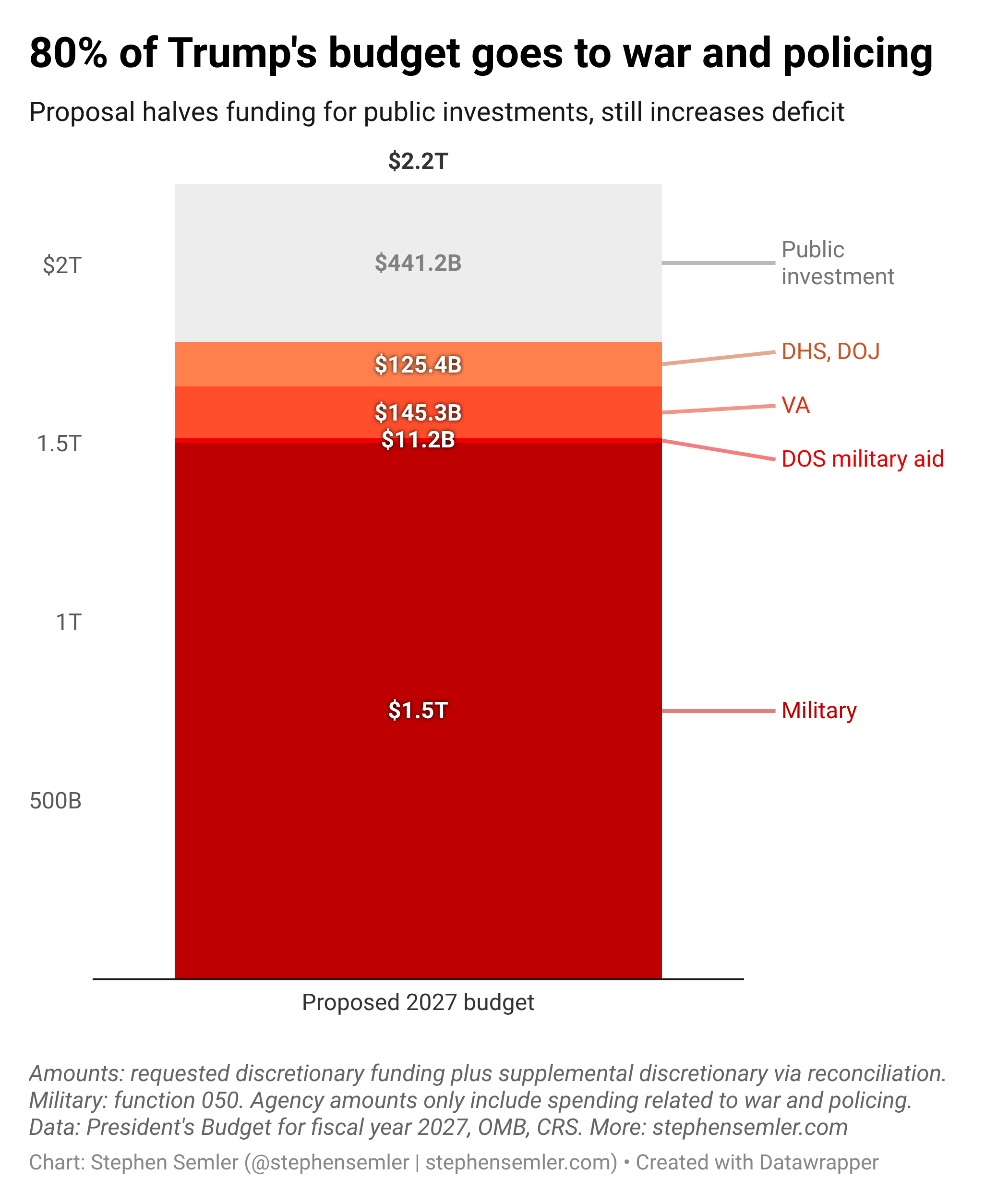
^Alt text for screen readers: 80% of Trump’s budget goes to war and policing. Proposal halves funding for public investments, still increases deficit. The red-orange stacked column chart is as follows: Military, $1.5 trillion; Department of State military aid, $11.2 billion; Department of Veterans Affairs, $145.3 billion; Departments of Homeland Security and Justice, $125.4 billion; Other, $441.2 billion. Amounts: requested discretionary funding plus supplemental discretionary via reconciliation. Military: budget function 050. Agency amounts only include funding related to war and policing. Data: President’s Budget for fiscal year 2027, Office of Management and Budget.
The chart above will draw criticism for three main reasons:
1. I clearly tried to make the graph look like a Rothko painting but didn’t quite pull it off.
Fair enough :(
2. I categorized veterans care as war-related spending.
Why isn’t the VA budget considered a public investment? First, it’s a war cost. Second, the care it delivers is exclusive, not public. Third, like other war-related funding, it crowds out other priorities. I’m not suggesting the VA budget be cut like I have for the Pentagon; I’m arguing that, like Pentagon spending, its growth displaces available funding for social programs and other public investments.
Military and non-military spending are the two fundamental categories of the budgets Congress passes each year. Generally speaking, congressional Republicans aim to increase the former and cut the latter; congressional Democrats used to prefer the opposite, but now want to increase both.
Both parties are heavily invested in the fight over the non-military amount — what happens to that number is a major part of how they gauge their political success. Both parties badly want to report “wins” to their base on this issue.
Republicans and Democrats appear to have come to a tacit agreement in recent years: increase non-military spending for military-adjacent programs (like veterans care) and policing functions while cutting public investment funding by nearly as much. Under this arrangement, both parties end up winners (different story for workers). Republicans can claim victory because public investments were cut, having been squeezed out of the non-military budget. Meanwhile, Democrats can tout historic increases in non-military spending.
It’s this budgetary sleight-of-hand that allowed Democratic leaders to boast in December 2022 that their 2023 budget bill — the final spending bill passed under the Democratic trifecta — included “the highest level for non-defense funding ever,” while cutting public investment spending by $55 billion ($99 billion in 2026 dollars).
In 1980, veterans care took up 4% of the non-military spending in the discretionary budget, 7% in 2000, and 10% in 2020. It jumped to 15% under Biden. Including the relevant DHS and DOJ funding, 24% of ostensibly non-military spending in Biden’s last enacted budget (2024) went to military-adjacent, militarized, or policing programs — the highest share on record to that point. It’s 25% this year, and 33% in Trump’s proposed budget for next year.
Trump’s proposal didn’t fall from the sky. The graph below shows that where the president wants to take us we’ve been headed for a while. It’s as if Trump observed a preexisting defect in US politics, then proceeded to inject it with vast quantities of epinephrine and anabolic steroids. (Note: To more clearly present the gap between military and public investment spending discussed above, the graph excludes VA, DHS, DOJ, and DOS funding.)
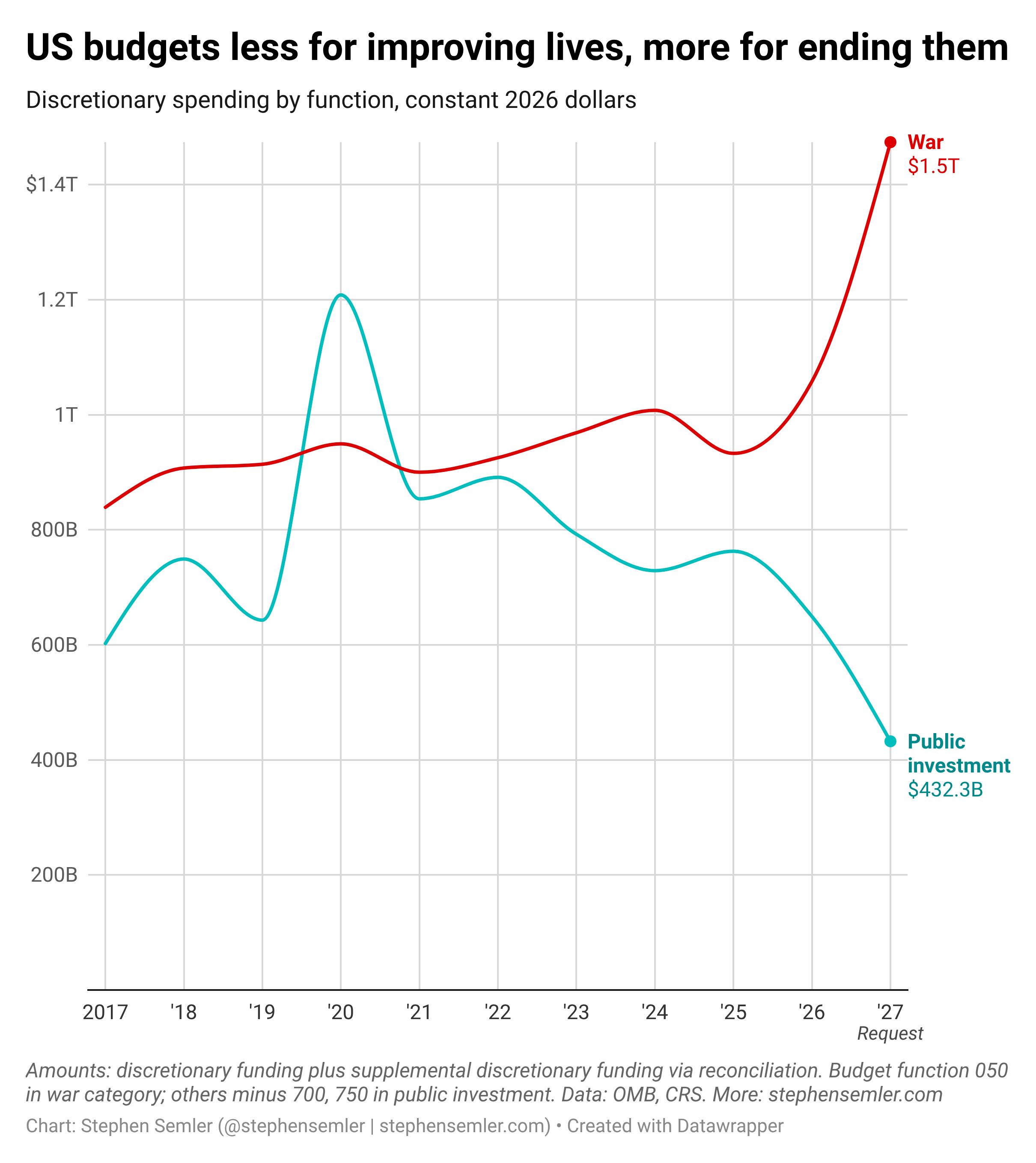
^Alt text for screen readers: US budgets less for improving lives, more for ending them. Discretionary spending by function, constant 2026 dollars. This chart shows war spending increasing steadily since 2017 and shows public investment spending peaking in 2020 before steadily falling ever since. Trump’s 2027 budget includes $1.5 trillion in war spending and only $432.3 billion in public investment. Amounts reflect discretionary funding plus supplemental discretionary funding via reconciliation. Budget function 050 in war category; others minus 700, 750 in public investment. Data: Office of Management and Budget, Congressional Research Service.
3. The discretionary budget doesn’t capture all government spending.
Indeed, discretionary spending is the money that the president proposes and Congress enacts each year through funding bills.4 Not included in the chart above is standard mandatory spending — primarily payments for benefits programs that are funded automatically through formulas — or interest on the national debt. Including those other two, the total projected budget for 2027 is $8.3 trillion.
Viewed in the context of all federal spending, funding for war and policing appears far less overwhelming. Or does it?
With the additional war- and policing-related spending in mandatory accounts (mostly disability and other payments to veterans), the total climbs from $1.8 trillion to $2.2 trillion.
So while it’s 80% of the proposed discretionary budget but only 26% of the entire projected budget, that 26% is more any other government expenditure. Here are the top five largest sources of US spending across discretionary and mandatory accounts for 2027:
War and policing: $2.2 trillion
Social Security: $1.8 trillion
Medicare: $1.2 trillion
Interest on debt: $1.1 trillion
Medicaid: $1.0 trillion
Including its share of the interest on the national debt, there’s $2.5 trillion for war and policing in the 2027 budget — 29% of the $8.3 trillion total.
SPECIAL THANKS TO: Abe B., Alan F., Alexander L., Alissa Q., Amin, Andrew R., AT., B. Kelly, Barbara B., Bart B., BeepBoop, Ben, Ben C.,* Bill S., Bob N., Brett S., Byron D., Carol V., Catherine L., Chris, Chris G., Claudia, Cole H., Coleman J., D. Kepler, Daniel M., Dave, David J., David S.,* David V.,* David M., Dharna N., Elizabeth R., Emily H.,* Errol S., Foundart, Fran Q., Francis M., Frank R., Fred R., Gary W., Gladwyn S., Graham P., Griffin R., Hunter S., IBL, Irene B., Isaac, Isaac L., Jacob, James G., James H., James N., Jamie LR., Jcowens, Jeff, Jennifer, Jennifer J., Jessica S., Jerry S., Joe R., John, John, John A., John K., John M., Jonathan S., Joseph B., Joshua R., Julia G., Julian L., Katrina H., Keith B., Kesh L., Kheng L., Lea S., Leah A., Leila CL., Lenore B., Linda B., Linda H., Lindsay, Lindsay S.,* Lora L., Lou B., Mapraputa, Marie R., Mark L., Mark G., Marvin B., Mary Z., Marty, Matthew H.,* Megan., Melanie B., Michael S., Mitchell P., Nick B., Noah K., Norbert H., Omar A., Omar D.,* Peter M., Phil, Philip L., Ron C., Rosemary K., Sari G., Scarlet, Scott H., Silversurfer, Soh, Springseep, Stan C., TBE, Teddie G., Theresa A., Themadking, Tim C., Timbuk T., Tony L., Tony T., Tyler M., Victor S., Viviane A., Wayne H., William H.,* William P.
* = founding member
-Stephen (Follow me on Instagram, Twitter, and Bluesky)
There’s no catch-all term for the wide array of government spending not tied to war and policing, and “public investment” is the best I could come up with. I decided on this term because it’s a flexible enough term to cover the functions I wanted but rigid enough to exclude those I didn’t. The term is used in different ways: it can refer to investing in long-term assets like infrastructure for economic growth, for example, or state investments in a much broader set of areas — including infrastructure, health, education, food systems, research, and so on — for broader development goals like improving living standards and well-being. As far as the two words in the term itself, “public” implies civilian-oriented (non-military) and non-exclusionary (unlike veterans care); “investment” implies productive spending — designed to produce a return like healthier workers, better socio-economic conditions, a reduction in the shittiness of everyday life, etc. — rather than a cost of ‘enforcing order’ (policing). The term isn’t as good as “social programs” for covering…social programs, but those appear to be increasingly viewed as investments rather than narrowly as welfare expenses. Terms I considered using instead — and perhaps should have — but ultimately didn’t due to my perception that they were either too limited in scope, too broad in scope, or sounded aspirational or outcomes-based rather than a dispassionate functional description: general welfare, domestic spending, domestic investments, civilian programs, social programs, quality of life funding, public services. Let me know if you can think of a better one.
In the DHS portion of the president’s budget, the administration states it plans on using “at least an estimated $31.4 billion” in reconciliation funding in 2027, but those funds don’t show up in the OMB tables. To estimate the real effect of reconciliation funding on DHS funding for “administration of justice” in 2027, I manually added $47,755 million in DHS funding on top of the funding in the OMB budget tables. That estimated amount reflects annualized DHS reconciliation funding over a four year period (2026-29). The White House budget request does include reconciliation resources for DOW but not for DHS.
What I’m saying is that the amounts reflect functional categories, not agency totals. Included functional categories: 050 National Defense; 152 International Security Assistance; 700 Veterans Benefits and Services; 750 Administration of Justice. You can see why I didn’t use this nomenclature and chose to use agency names instead, which anchor the funding to a familiar entity. (That said, I will drop a “budget function 050” or related argot from time to time, which is mainly to signal that I write in plain language everywhere else by choice.)
Why focus on the discretionary budget? Because it’s the money lawmakers control, it funds far more government programs per dollar than mandatory spending, and the government shuts down without it. In short: it’s highly relevant and great for evaluating presidential and congressional priorities.
I get my care at the VA so it's wild the see these numbers in visual, Stephen. Even crazier, we've had cuts since Barrack Obama signed the Choice Act in 2014 (had a 3 year sunset clause) and then re-affirmed in Donald Trump's signature of the Mission Act 2018. (Fuck, the only vets who get covered since 2004 are those with 20% service connected disability. Not every vet gets care and that's criminal.) In both cases, more vets were dis-enrolled as departments streamlined by sending cash to private health insurance pirates TriWest Healthcare and Health Net to take care of us. Care was worse by 2017, check out reports by ex-Senator Tester out of Montana, but the lucrative contracts kept TriWest and Health Net rolling.
Point is, this is the hustle of our lives: "privatization" in damn near every sector of governance has always been a lucrative contract to the friends of liberals AND republicans in the private sector. TriWest, for example, is based in Arizona, it's president was David J. McInTyre who just happened to be on John McCain's staff back in the day. And Obama took, what, 3x the amount of the health insurance pirates over McCain in 2008 election?
Even though we're still the Honda Accord of American healthcare, we're getting less as vets but ya'll are paying more to these slush puppies. MAGA Red or MAGA Blue, it's all the same shakedown.