

IN THIS NEWSLETTER: Trump has cut off food aid to more than 5 million people. But is Trump’s SNAP cut worse than Biden’s?
*Thank you, SNJ, for becoming a paid subscriber! Join SNJ and the other Polygraph VIPs to support my work.
What food assistance cliff?
The one illustrated below, brought about by the July 2025 passage of the One Big Beautiful Bill Act (OBBBA), the Trump administration’s flagship legislation.
Enrollment in the Supplemental Nutrition Assistance Program (SNAP, formerly known as food stamps) has dropped by more than 5 million people since July 2025. SNAP enrollment had been fairly steady since April 2021 — hovering around 42 million participants — before dropping off sharply after OBBBA was signed into law. There are fewer than 37 million SNAP enrollees according to the latest data from the Department of Agriculture (USDA).1
Such an abrupt drop-off in SNAP participation means one of two things happened. Either millions of people suddenly stopped needing food assistance, coincidentally beginning in July 2025, or OBBBA is driving millions of people off SNAP. Nothing I’ve read suggests the former, though admittedly I haven’t read much Trump fan fiction. There is, however, real-world evidence supporting the latter.
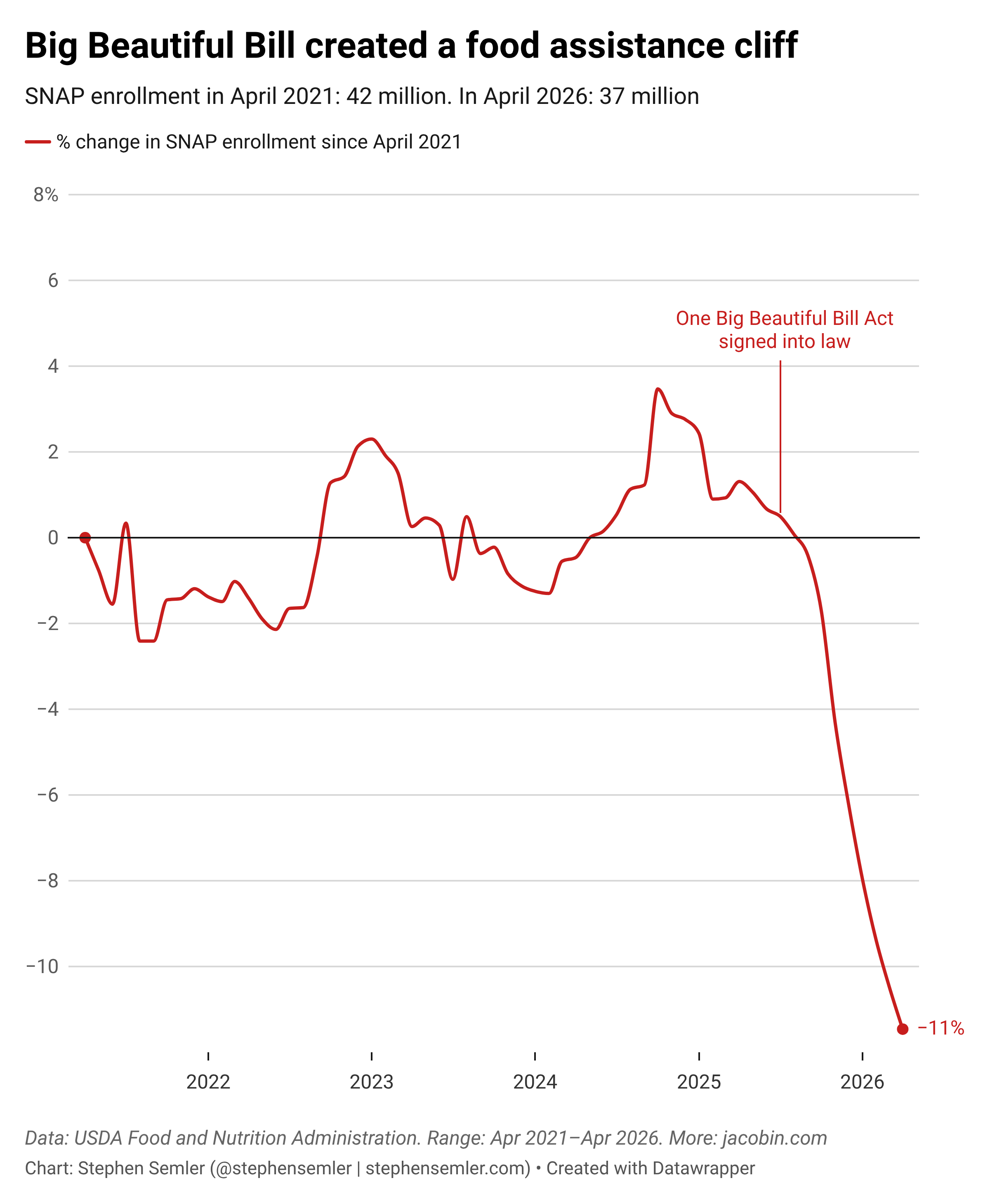
^Alt text for screen readers: Big Beautiful Bill created a food assistance cliff. SNAP enrollment in April 2021: 42 million. In April 2026: 37 million. Line graph shows the percent change in SNAP enrollment since April 2021. From April 2021 to June 2025, enrollment fluctuated largely within two percentage points relative to April 2021, but when the One Big Beautiful Bill Act was signed into law in July 2025, enrollment took a nosedive. As of April 2026, it’s at –11%. Data: USDA. Data range: April 2021 to April 2026. Chart source: https://jacobin.com/2026/08/trump-ice-budget-snap-food-insecurity
How Trump’s flagship bill cuts food assistance
One of the ways OBBBA created a food assistance cliff is by expanding work requirements for SNAP participants. Groups newly subject to SNAP work requirements include adults ages 55 to 64, those with dependent children ages 14 to 17, people experiencing homelessness, veterans, and 18- to 24-year-olds transitioning out of foster care. These groups must now complete and report at least 80 hours of work per month in order to be eligible to receive food assistance.
It’s not the expanded work requirements per se that will produce the bulk of the GOP’s intended SNAP “savings.” Rather, it’s the additional red tape they create.
The main reason people lose SNAP benefits is not ineligibility, but a failure to submit paperwork (re)verifying their eligibility. Make of that what you will, but I’ll just say that failing to submit the proper paperwork for rigorously means-tested programs like SNAP or Medicaid is surprisingly easy.
It’s fitting that the same bill that created the food assistance cliff also sent ICE $75 billion — more money than the agency has shown it knows what to do with. This juxtaposition is examined in my latest article in Jacobin, While Trump Cuts Food Aid, ICE Sits on $100 Billion. Food aid was effectively taken from the needy and given to ICE.2
Trump’s SNAP cut is actually the second major cut to the program in recent years. Here’s how it compares to the first.
Trump’s SNAP cut vs. Biden’s
Average monthly SNAP benefits are $1 billion lower than they were pre-OBBBA. This billion-dollar reduction was achieved by shedding enrollees — SNAP participation fell by 5 million people from July 2025 to April 2026 — rather than by substantially cutting benefits, which fell by an inflation-adjusted $3 per person per month, on average, during the same stretch.
By contrast, Biden’s SNAP cut was achieved primarily through reducing benefits. What was Biden’s SNAP cut? It’s the one that quietly cut monthly SNAP benefits by a third. Here’s how it went down.
In response to Covid-19, Congress passed the Families First Coronavirus Response Act in March 2020. Sec. 2302 of the bill started supplemental SNAP benefits called emergency allotments, which provided at minimum $95 in additional monthly benefits per household for as long as the Covid-19 Public Health Emergency remained in effect.3
Because SNAP emergency allotments did not require funding from Congress and Congress does not have the authority to terminate Public Health Emergencies,4 the extra SNAP benefits would persist for as long as the Biden administration wanted them to. To get rid of the extra SNAP benefits, the Biden administration would have to either a) declare an end to the Public Health Emergency (or refuse to renew it); or b) sign legislation ending SNAP emergency allotments.
Biden did both.
In May 2023, the Biden administration terminated the Covid-19 Public Health Emergency. SNAP emergency allotments ended two months earlier, thanks to the Consolidated Appropriations Act, 2023 (CAA 2023), a $1.7 trillion spending bill. The bill included a sunset provision (Division HH, Title IV, Section 503(b)) for the extra SNAP benefits — which had kept 4.2 million people out of poverty — that took effect after February 2023.
After Biden urged its “swift passage,” all but one congressional Democrat voted for CAA 2023 (Rep. Ocasio-Cortez, D-NY). Biden signed the bill into law on December 29, 2022. This left 43 million SNAP recipients only about 60 days to brace for a drastic reduction in food assistance. And that’s if they heard about it — the provision was buried on page 1536 of a 1653-page bill that was quickly passed over the holidays.
The result: disaster. After emergency allotments ended, household food insufficiency increased by 5%, child food insufficiency by 6%, and both by 21% among SNAP recipients. Other studies had similarly grim findings. This more than canceled out the beneficial SNAP reforms from earlier in Biden’s presidency.5
Nine months after Biden signed CAA 2023 into law in December 2022, average monthly SNAP benefits had fallen by $90 per person and $173 per household. Despite Trump’s SNAP cut disenrolling five times as many people after nine months — 5 million to Biden’s 1 million — Biden’s SNAP cut reduced monthly benefits by four times as much in the same amount of time: $4 billion, compared with Trump’s $1 billion.6
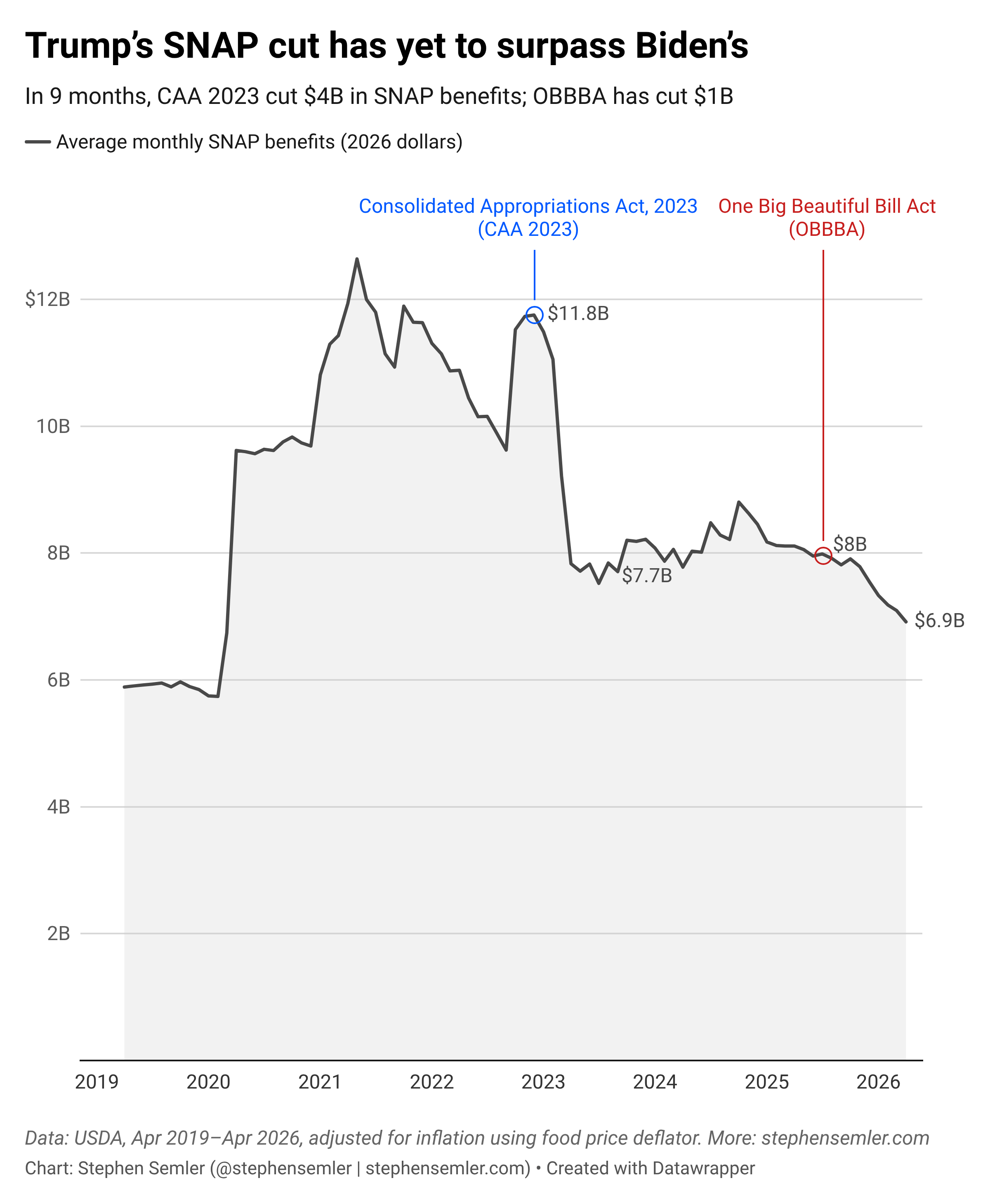
^Alt text for screen readers: Trump’s SNAP cut has yet to surpass Biden’s. In 9 months, Consolidated Appropriations Act, 2023 cut $4 billion in SNAP benefits; One Big Beautiful Bill Act has cut $1 billion. This line graph shows average monthly SNAP benefits in 2026 dollars. December 2022, $11.8 billion; September 2023, $7.7 billion. July 2025, $8 billion; April 2026, $6.9 billion. Data: USDA, April 2019 to April 2026, adjusted for inflation using food price deflator.
An optimistic reading of the chart above is that average monthly SNAP benefits are higher in inflation-adjusted terms than they were pre-Covid. For example, from when the chart begins in April 2019 to when it ends in April 2026, average monthly SNAP benefits increased by $30 per person ($157 to $187) and $31 per household ($312 to $343). Benefits were higher, often considerably, in the months in between.
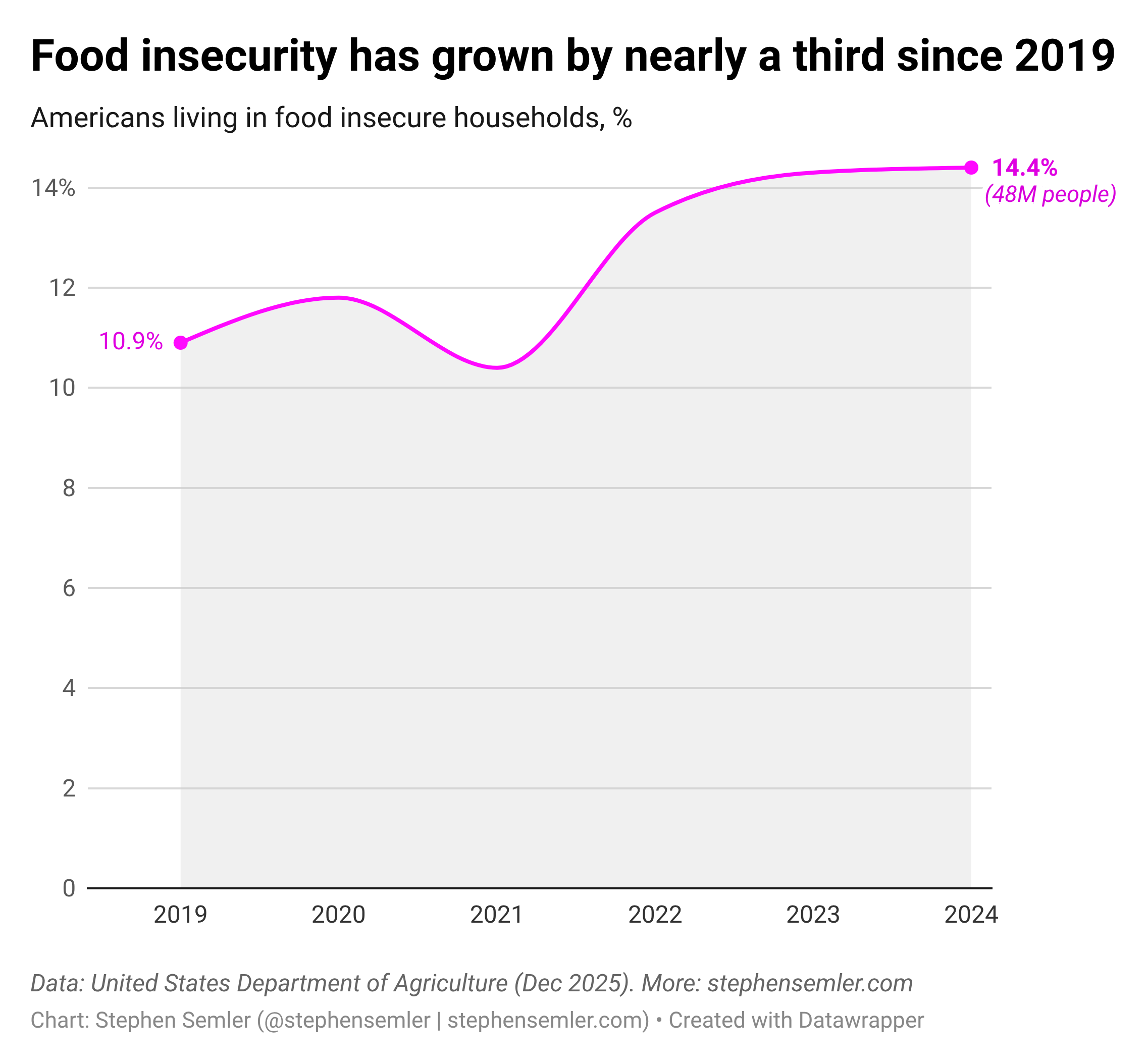
However, hunger hasn’t subsided to 2019 levels — save for 2021, during the pandemic welfare state’s peak7 — according to the USDA’s latest food security report. The Trump administration’s decision to discontinue that annual report is a strong indication of where food insecurity is headed.
^Source: https://www.stephensemler.com/i/184047970/2-trump-has-no-plan-to-fix-the-affordability-crisis
SPECIAL THANKS TO: Abe B., Alan F., Alexander L., Alissa Q., Amin, Andrew R., AT., B. Kelly, Barbara B., Bart B., BeepBoop, Ben, Ben C.,* Bill S., Bob N., Brett S., Byron D., Carol V., Catherine L., Chris, Chris G., Claudia, Cole H., Coleman J., D. Kepler, Daniel M., Dave, David J., David S.,* David V.,* David M., Dharna N., Elizabeth R., Emily H.,* Errol S., Ethan R., Foundart, Fran Q., Francis M., Frank R., Fred R., Gary W., Gladwyn S., Graham P., Griffin R., Heath P., Hunter S., IBL, Irene B., Isaac, Isaac L., Jacob, James G., James H., James N., Jamie LR., Jcowens, Jeff, Jennifer, Jennifer J., Jessica S., Jerry S., Joe R., John, John, John A., John K., John M., Jonathan S., Joseph B., Joshua R., Julia G., Julian L., Katrina H., Keith B., Kesh L., Kheng L., Lea S., Leah A., Leila CL., Lenore B., Linda B., Linda H., Lindsay, Lindsay S.,* Lora L., Lou B., Mapraputa, Marie R., Mark L., Mark G., Marvin B., Mary Z., Marty, Matthew H.,* Megan., Melanie B., Michael S., Mitchell P., Nick B., Noah K., Norbert H., Omar A., Omar D.,* Peter M., Phil, Philip L., Ron C., Rosemary K., Sari G., Scarlet, Scott H., Silversurfer, SNJ, Soh, Springseep, Stan C., TBE, Teddie G., Theresa A., Themadking, Tim C., Timbuk T., Tom B., Tony L., Tony T., Troy, Tyler M., Victor S., Viviane A., Wayne H., William H.,* William P.
* = founding member
-Stephen (Follow me on Instagram, Twitter, Bluesky, and Threads.)
The latest available data were for April 2026 as I was writing this piece, but USDA apparently published the May 2026 data a few hours ago. SNAP enrollment is still roughly 37 million, albeit a lower 37 million than in April. April 2026: 37,078,596; May 2026: 36,562,128 (-516,468).
The food aid wasn’t literally consumed by ICE, despite what the average ICE agent’s physique might suggest.
States could opt out, and some did. While all 50 states took advantage of SNAP emergency allotments in 2020 and 2021, 18 states eventually declined to accept the extra SNAP benefits before SNAP EAs expired at the end of February 2023. The state governor being Republican was the only significant predictor for a state’s decision to turn down the extra SNAP benefits for their residents.
If this sounds incorrect, you’re likely thinking of national emergency declarations — different from Public Health Emergency declaration — which can be terminated through a joint resolution of Congress.
Namely, the update to the Thrifty Food Plan for fiscal year (FY) 2022. Biden is also credited with two other SNAP reforms, but that credit requires some caveats.
The Biden administration changed the USDA’s policy of denying emergency allotments to households already receiving the maximum SNAP benefit, as the agency had done under Trump. However, it appears that litigation is chiefly responsible for that change rather than an inherent desire for better policy. The USDA issued revised guidance 72 days after the start of Biden’s term on April 1, 2021, one day after a settlement was reached in Gilliam v. USDA and hours after a settlement was reached in Hall v. USDA, both of which challenged the USDA’s previous interpretation of the Families First Coronavirus Response Act (FFCRA), which authorized the emergency allotments.
Biden created a permanent summer EBT program through the same bill (CAA 2023) which provides a maximum $120 in food assistance per child per summer. This is a dubious achievement considering it came at the expense of a better version of the same program. The permanent summer EBT program established by CAA 2023 replaced the pandemic summer EBT program that provided a maximum of $391 in food aid per child per summer — $271 more than the version Biden replaced it with. Like SNAP emergency allotments, pandemic EBT benefits were tied to the Public Health Emergency, which the Biden administration could have extended indefinitely: the pandemic EBT program was established by the FFCRA through FY2020, extended by CAA 2021 through FY2021, and then extended indefinitely by ARPA for as long as the Public Health Emergency remained in effect. What’s more, the CAA 2023 summer EBT program eliminated eligibility for kids who are homeschooled or enrolled in fully virtual institutions — students who were covered under the pandemic summer EBT program.
The dollar amounts above and below are adjusted for inflation using a food price deflator (I found nearly identical results using this food deflator) as opposed to using a broad inflation index like CPI, which is far less responsive to spikes in food prices specifically. Naturally, OBBBA prohibits the automatic annual SNAP benefit increases from outpacing general inflation. The big jump in SNAP benefits you see in the graph in October 2022 — the start of FY2023 — reflects an automatic cost-of-living adjustment after the historic increase in food prices during FY2022. Cruelly, the increase in food aid was followed by a cut more than twice its size a few months later when CAA 2023’s SNAP cut took effect.
Maximum SNAP benefits were increased by 15% from January to June 2021 by the Consolidated Appropriations Act, 2021 (enacted December 2020), and extended through September by the American Rescue Plan Act (enacted March 2021). That’s in addition to all the pandemic welfare programs illustrated here, all of which in effect for at least part of 2021.