
What $1.5 trillion for the Pentagon could fund instead
Polygraph | Newsletter n°340 | 27 Apr 2026

IN THIS NEWSLETTER: What $1.5 trillion could do outside the Pentagon.
*Findings from the previous Polygraph newsletter were featured in this Forbes op-ed and this Yale debate. Thank you to my paid subscribers for making that research possible.
*Big thanks to Heath P. and Ethan R. for becoming paid subscribers! Join them and the other Polygraph VIPs to support my work.
Situation
President Trump’s budget proposal for next year manages to be $361 billion larger than last year’s despite cutting $300 billion in social programs and other public investments. The main reason is the vast increase in military spending.
The $1.504 trillion military budget serves as the lifeblood for Trump’s next war(s) and his justification for slashing social programs. “We’re fighting wars,” Trump said earlier this month. “It’s not possible for us to take care of daycare, Medicaid, Medicare, all these individual things…we have to take care of one thing: military protection.” The White House tried and failed to message its way out of the resulting public backlash. A few days earlier, Secretary of State Marco Rubio said, “Imagine if instead of spending billions of dollars supporting terrorists or weapons, Iran had spent that money helping the people of Iran.”
US infrastructure for drinking water and wastewater received C– and D+ grades respectively from the American Society of Civil Engineers last year. Next year’s budget proposal slashes funding for water infrastructure. For the Pentagon, a river of money; for workers, a river of effluent.
What $1.5 trillion could fund instead
Federal agencies released detailed budget justifications early this month in time with the White House’s overarching budget, but the Pentagon’s was delayed until a few days ago. Why? Budgeting beyond WWII-level military spending when there’s nowhere near WWII-level military demand has created a glut, an overabundance, un embarras de richesses — a fact made clear in this actual headline in the Washington Post: “Trump aides struggle with how to spend $500 billion more on military.” A $1.5 trillion budget is more than the Pentagon knows what to do with.
One way to express the severity of this failure of governance is to illustrate what $1.5 trillion could accomplish when put toward other ends. Oddly, doing so makes the Pentagon’s “problem” somewhat relatable — $1.5 trillion really is a hell of a lot of money. The graph below shows what I did with the equivalent of Trump’s proposed 2027 military budget. Globally, I eliminated hunger and extreme poverty; domestically, I ended homelessness, covered every person without health insurance with Medicaid, implemented universal pre-K for three- and four-year olds, issued another round of $600 relief checks, and built enough solar infrastructure to power half of all households. I still have $77 billion left over.
What’s more, while the massive, trillion-dollar-plus annual military budgets like Trump proposed for 2027 are “the new normal,” the $596 billion for solar and $141 billion for relief checks are one-time costs. Only $690 billion is for yearly expenses (though the $93 billion for world hunger isn’t planned to be needed after 2030).
Methodology is below the chart.
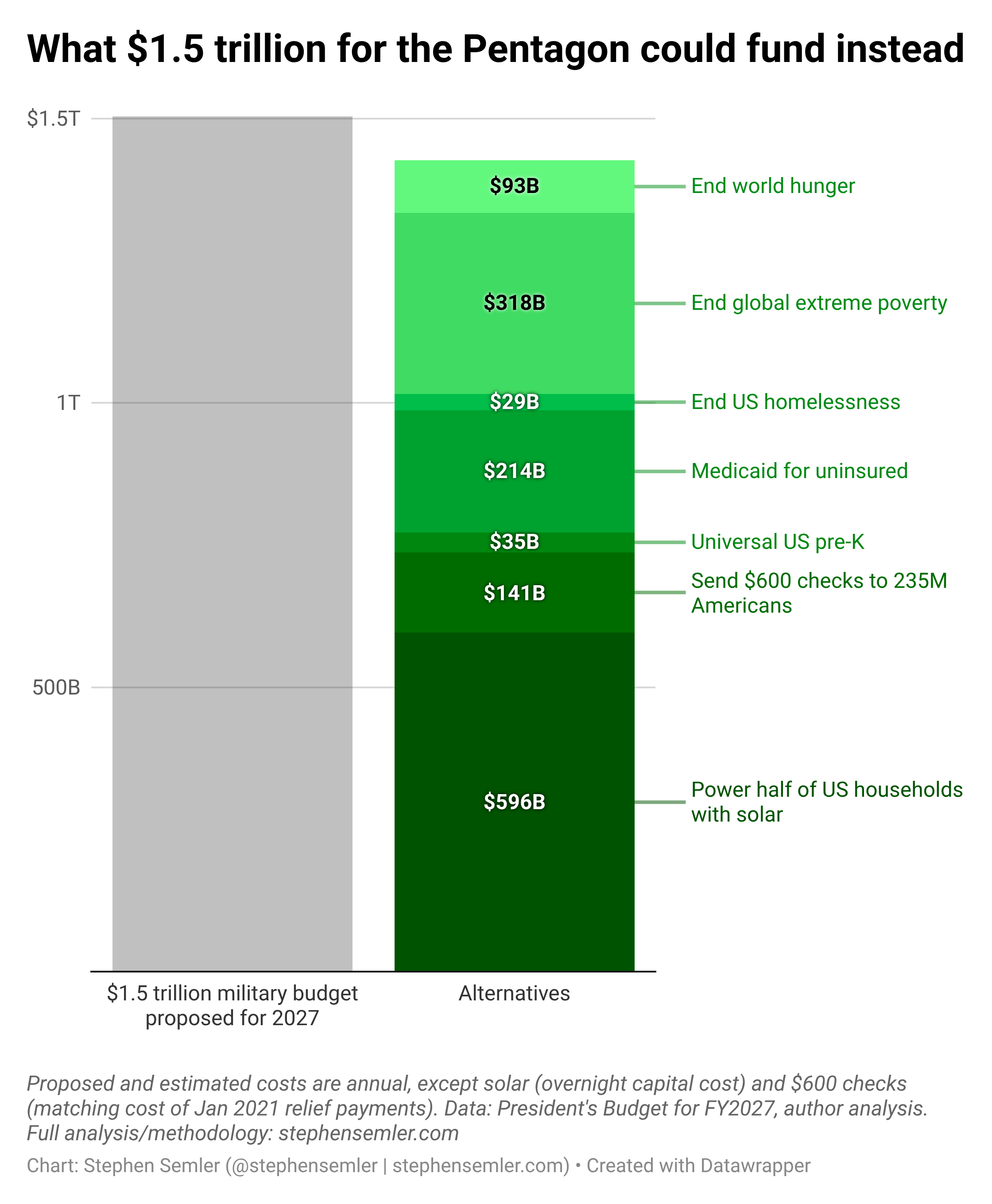
^Alt text for screen readers: What $1.5 trillion for the Pentagon could fund instead. This column chart compares the $1.504 trillion requested military budget for 2027 against a set of alternatives. In billions: 93, End world hunger; 318, End global extreme poverty; 29, End US homelessness; 214, Medicaid for uninsured; 35, Universal US pre-K; 141, Send $600 checks to 235M Americans; 596 , Power half of US households with solar. Proposed and estimated costs are annual, except solar (overnight capital cost) and $600 checks (matching cost of January 2021 relief payments). Data: President’s Budget for fiscal year 2027, author analysis.
Methodology
Power half of US households with solar
There are 134.8 million US households (as of Dec 2025) and 50% of that is 67.4 million. On average, each household uses 10,500 kWh of electricity per year, creating an annual electricity demand of 707.7 billion kWh.
Assuming a 25% capacity factor, 1 kW of utility-scale solar produces an average of 2,190 kWh per year (0.25 times 8,760 hours in a year). Dividing 707.7 billion kWh by 2,190 kWh per kW equals 323.1 million kW, the estimated utility-scale solar capacity required to meet household demand.
According to the Department of Energy’s PV System Cost Model, the estimated cost per kW is $1,488 to $2,200 for MSP. I chose the midpoint — $1,844 — for this analysis. Multiplying 323.1 million kW by $1,844 equals $595.8 billion, the estimated one-time cost to build the solar capacity to power half of US households.
Note that this estimate includes energy storage, allowing solar power to be delivered at night rather than only matching aggregate electricity demand. DOE’s model calculates the cash cost of an installed system by factoring in the following expenses:
Module – The cost to the installer of photovoltaic modules, as delivered.
Inverter – The cost to the installer of equipment for converting direct current (dc) to alternating current (ac), as delivered.
Energy Storage System (ESS) – The cost to the installer of adding an energy storage system, as delivered.
Structural Balance of System (SBOS) – The cost to the installer of structural balance of system components, as delivered.
Electrical Balance of System (EBOS) – The cost to the installer of electrical balance of system components, as delivered.
Fieldwork – The cost to the installer of work performed at the installation site.
Office work – The cost to the installer of work performed off-site.
Other – Costs incurred by the project developer not included elsewhere.
Send $600 checks to 235M Americans
Division N of Title II of the Consolidated Appropriations Act, 2021 (P.L. 116-260), provided $600 “recovery rebates” to eligible taxpayers, providing $141 billion in tax relief, according to IRS data. There were 146.5 million second-round tax rebate payments, including 41.7 million to married couples filing a joint return. All told, the $600 checks reached about 235 million Americans, including dependents (eligible filers also received $600 per child).
Universal US pre-K
The simple annualized cost is $35.1 billion, based on Penn Wharton’s estimate (“We estimate that nationwide universal preschool education for three- and four-year-olds will cost $351 billion over the next 10 years.”)
Medicaid for uninsured
There are 27.1 million Americans without health insurance, according to the Census Bureau (2024). Average annual Medicaid spending per full-benefit enrollee is $7,909, according to KFF (2023). Multiplying these two numbers together gives you $214.4 billion.
End US homelessness
The National Alliance to End Homelessness (NAEH) estimates it would cost $15.1 billion to fully address sheltered homelessness through a Housing First policy. This policy is about getting people without a home into one as quickly as possible and for as long as needed. Optional support services are offered as well.
My estimate is nearly double NAEH’s for two reasons. First, the NAEH figure is also calibrated to 2022, and homelessness has rapidly increased since then. I accounted for the rise in homelessness using the latest population data from the Department of Housing and Urban Development (HUD). HUD’s point-in-time counts show sheltered homelessness rising from 348,630 in 2022 to 497,256 in 2024 — a 43% increase — yielding an adjusted cost estimate of roughly $21.5 billion to cover the current sheltered population. Second, the NAEH figure applies to sheltered homelessness but not unsheltered.
To account for unsheltered homelessness, I adjusted the $21.5 billion figure upward by 36%, matching the share of people experiencing homelessness who are unsheltered (274,224 out of 771,480). This yields an estimated $29.1 billion annual budget.
This is a rough estimate. Combining the strongest available cost model with the most recent population data requires bridging different measurement systems: the NAEH cost model is based on households counted over the course of the year while the HUD data counts individual people at a single point during a year. As a result, there are simplifying assumptions, like household homelessness increasing proportionately with individual homelessness and per-household costs remaining consistent across time and populations.
End global extreme poverty
A recent working paper estimates that the cost of ending extreme poverty through direct cash transfers is $318 billion, or roughly 0.49% of OECD GDP.
The US would not be expected to front the entire cost. If the US financial contribution matched its contribution to the UN regular budget (22% in 2025), the annual cost to the US would be $70 billion.
End world hunger
Ending world hunger by 2030 would cost $93 billion per year, according to UN estimates.
The US wouldn’t be expected to front the entire cost. If the US financial contribution matched its contribution to the World Food Programme (32% as of 2025), the annual cost to the US would be $29.5 billion through 2030.
SPECIAL THANKS TO: Abe B., Alan F., Alexander L., Alissa Q., Amin, Andrew R., AT., B. Kelly, Barbara B., Bart B., BeepBoop, Ben, Ben C.,* Bill S., Bob N., Brett S., Byron D., Carol V., Catherine L., Chris, Chris G., Claudia, Cole H., Coleman J., D. Kepler, Daniel M., Dave, David J., David S.,* David V.,* David M., Dharna N., Elizabeth R., Emily H.,* Errol S., Ethan R., Foundart, Fran Q., Francis M., Frank R., Fred R., Gary W., Gladwyn S., Graham P., Griffin R., Heath P., Hunter S., IBL, Irene B., Isaac, Isaac L., Jacob, James G., James H., James N., Jamie LR., Jcowens, Jeff, Jennifer, Jennifer J., Jessica S., Jerry S., Joe R., John, John, John A., John K., John M., Jonathan S., Joseph B., Joshua R., Julia G., Julian L., Katrina H., Keith B., Kesh L., Kheng L., Lea S., Leah A., Leila CL., Lenore B., Linda B., Linda H., Lindsay, Lindsay S.,* Lora L., Lou B., Mapraputa, Marie R., Mark L., Mark G., Marvin B., Mary Z., Marty, Matthew H.,* Megan., Melanie B., Michael S., Mitchell P., Nick B., Noah K., Norbert H., Omar A., Omar D.,* Peter M., Phil, Philip L., Ron C., Rosemary K., Sari G., Scarlet, Scott H., Silversurfer, Soh, Springseep, Stan C., TBE, Teddie G., Theresa A., Themadking, Tim C., Timbuk T., Tony L., Tony T., Tyler M., Victor S., Viviane A., Wayne H., William H.,* William P.
* = founding member
Thanks for visioning an alternative to the omnicide budget of $1.5T, “the severity of this failure of governance”, that can’t defend for how missile drones have changed “modern” warfare and still having the sixth largest military budget equivalent to India’s left over with $77B.