
How much aid has the US given Israel?
Polygraph | Newsletter n°332 | 20 Jan 2026

IN THIS NEWSLETTER: Congress plans to give Israel $4 billion in 2026 — here’s how much the US has already given the country.
*ICYMI: War is Trump’s answer to the affordability crisis
*Thank you, Catherine L., for supporting Polygraph! If you’re enjoying this newsletter, please consider joining Catherine and the other paid subscribers thanked at the bottom of each note.
Situation
Last week, the House passed legislation funding the State Department for the rest of the year by a 341–79 margin, as part of a two-bill “minibus.” This morning, the Senate released the text of a four-bill spending minibus, including the Pentagon.
Between the pending 2026 budget bills for the State Department and Pentagon, there’s more than $4 billion in aid for Israel. Here’s a breakdown of this $4,017,117,000:
State Department bill
$3.3 billion in military aid, of which “not less than” $250.3 million is for Israel to spend on arms from Israeli companies. The remaining amount functions as a gift card for Israel to buy US weapons.1
This amount is in line with the terms of the ten-year Memorandum of Understanding between the US and Israel that has been in effect since 2019. However, contrary to popular belief, the MOU isn’t legally binding. The US gives billions of dollars in military aid to Israel each year because each year, Congress decides to do so.
$14.6 million in economic aid, including $117,000 for an Israeli scholarship program, $3 million for Israeli development programs, $5 million for “historical, archaeological, and cultural initiatives, including in Jerusalem, that strengthen and deepen the United States-Israel special relationship,” and $6.5 million for resettling refugees in Israel.
Meanwhile, the bill prohibits funding for UNRWA, originally established by the UN General Assembly to provide relief to the Palestinians expelled by Israel during the Nakba.2 It also prohibits funding for UN investigations into Israeli human rights violations. The bill requires certification that the Palestinian Authority is “acting to counter incitement of violence against Israelis and is supporting activities aimed at promoting peace, coexistence, and security cooperation with Israel” in order to be eligible for humanitarian or development assistance.
Pentagon bill
$702.5 million in military aid, including $500 million for missile programs, $80 million for anti-tunneling, $75 million for counter-drone, and $47.5 million for “emerging technology.”
The Pentagon’s Israel aid programs are labeled as “cooperative,” implying an equally shared burden and benefit. In reality, it’s just more military aid. For example, $273 million of the $500 million in missile aid in 2026 is for the Arrow 3 system, even though the US has never purchased the Arrow system and has never intended to.3
How much aid has the US given Israel?
By the time the House passed the 2026 bill with $3.3 billion for Israel, the US had already given Israel $352 billion in aid since its founding. This includes $263 billion in military aid and $89 billion in economic assistance. These inflation-adjusted amounts4 are shown on a cumulative basis in the graph below.
These figures are the products of my own research — research that I wouldn’t have made the effort to do if I thought existing figures fully captured US aid to Israel. I found over $7 billion in aid that was previously unaccounted for, mostly through a FOIA request on an obscure military assistance program. This amounts to a 2% improvement over the existing data — framed this way, my contribution sounds considerably less impressive.
The methodology section (just south of the chart) compares my findings to the three most widely cited sources on the question posed above: USAFacts, Council on Foreign Relations, and the Congressional Research Service. No two sources offer the same findings, largely because foreign aid data has to be pieced together. While the US government maintains a foreign aid database (ForeignAssistance.gov), it doesn’t cover all assistance programs, funding levels for those programs only go back to 2001, and there’s a lag time in reporting. Moreover, due to transparency issues in US foreign assistance — particularly regarding Israel — everyone’s findings are estimates. Some estimates are better than others, though.
*
The chart below starts in 1951, when the US began providing economic aid to Israel. Military assistance started in 1959. Cumulatively, the latter overtook the former in 1974, and the gap has progressively widened, particularly since economic aid fell off in the late 1990s–early 2000s. Israel still receives economic assistance — $24 million per year over the last decade, on average — but the cumulative effect is nearly imperceptible when juxtaposed with the billions of dollars in annual military aid. (For examples of how Israel uses the weapons it acquires with US military aid, see here and here.)
The military aid illustrated in the graph adhere to a bureaucratic definition of the term, meaning that only funding provided to Israel through official military assistance and “cooperative” programs is counted. For example, the $6 billion the US spent directly defending Israeli territory against counterattacks by Iran in April 2024, October 2024, and June 2025 doesn’t count as military assistance, even though the US was literally assisting Israel militarily. The point is that yes, the aid figures are enormous, and no, they don’t fully capture the financial costs of the US’s Israel policy.
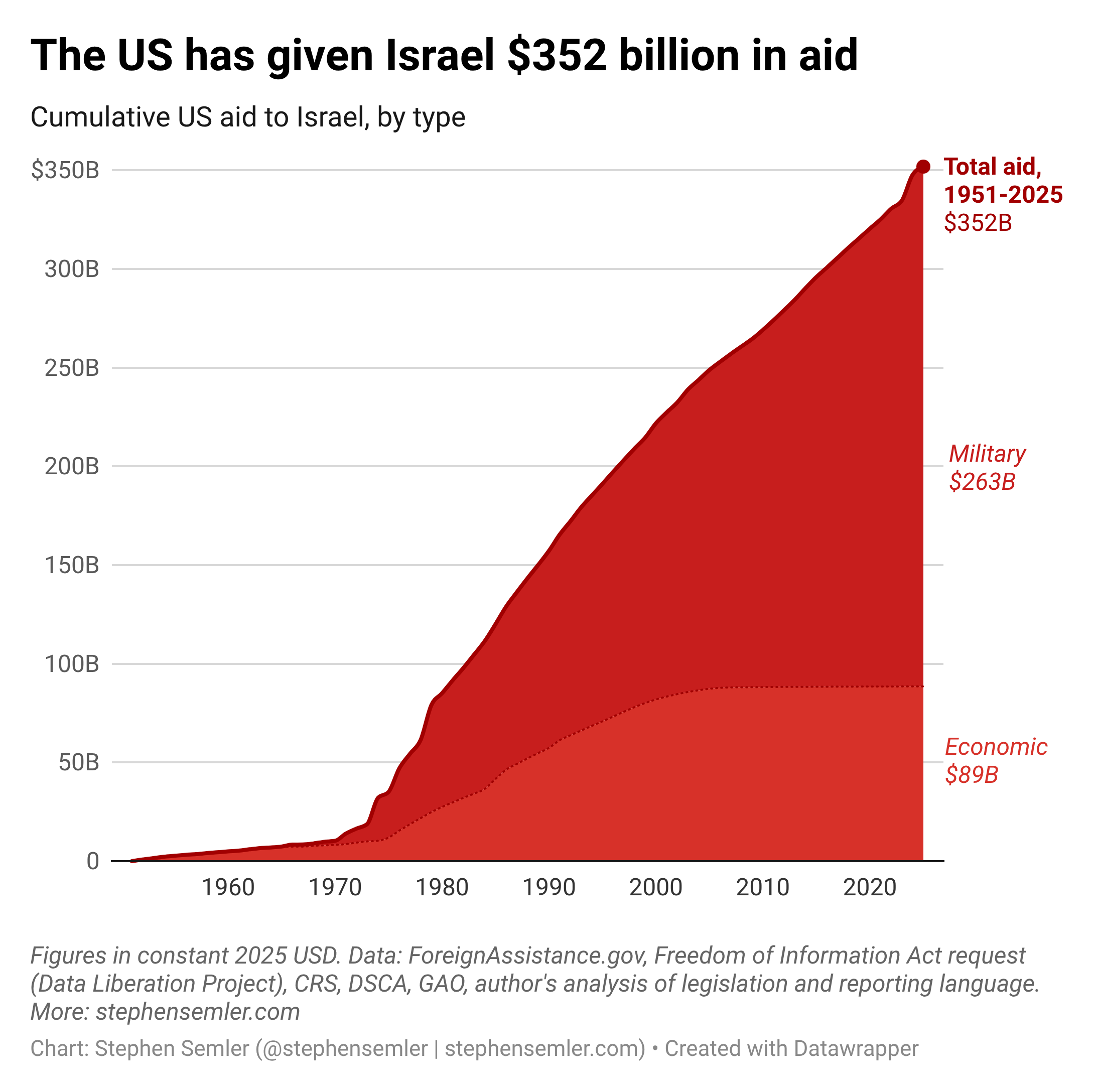
^Alt text for screen readers: The U.S has given Israel $352 billion in aid. Cumulative U.S. aid to Israel, by type. Total aid, 1951 to 2025, $352 billion; including $263 billion in military aid and $89 billion in economic aid. Figures in constant 2025 U.S. dollars. Data: ForeignAssistance.gov, Freedom of Information Act request (Data Liberation Project), CRS, DSCA, GAO, author’s analysis of legislation and reporting language.
Methodology
It’s just methodological talk from here on, so feel free to attend to the rest of your emails. Thanks for opening this one.
Foreign aid data isn’t stored in one place. However, the bulk of it can be found at ForeignAssistance.gov, which is jointly managed by the State Department and USAID (or what’s left of it). First, use the live dashboard for funding data going back to 2001. Second, consult the static U.S. Overseas Loans and Grants “Greenbook” for the years before 2001. Third (optional), cross-reference the overlap period (2001–20), and reconcile any discrepancies.
This is more or less the starting point for each of the following four sources on all-time US aid to Israel: USAFacts, Council on Foreign Relations, Congressional Research Service, and Polygraph. What separates them is the level of effort in accounting for the foreign aid not included in State-USAID data.
USAFacts
A hefty portion of military aid to Israel is funded by the Pentagon. Most Pentagon-funded aid is for missile programs. This missile aid is not included in the State-USAID data. Not counting missile aid in a typical year means omitting $500 million in military aid to Israel. In 2024, it meant omitting $5.7 billion.
USAFacts based its graph only on State-USAID data and is therefore missing $18.5 billion5 from the missile aid omission alone.
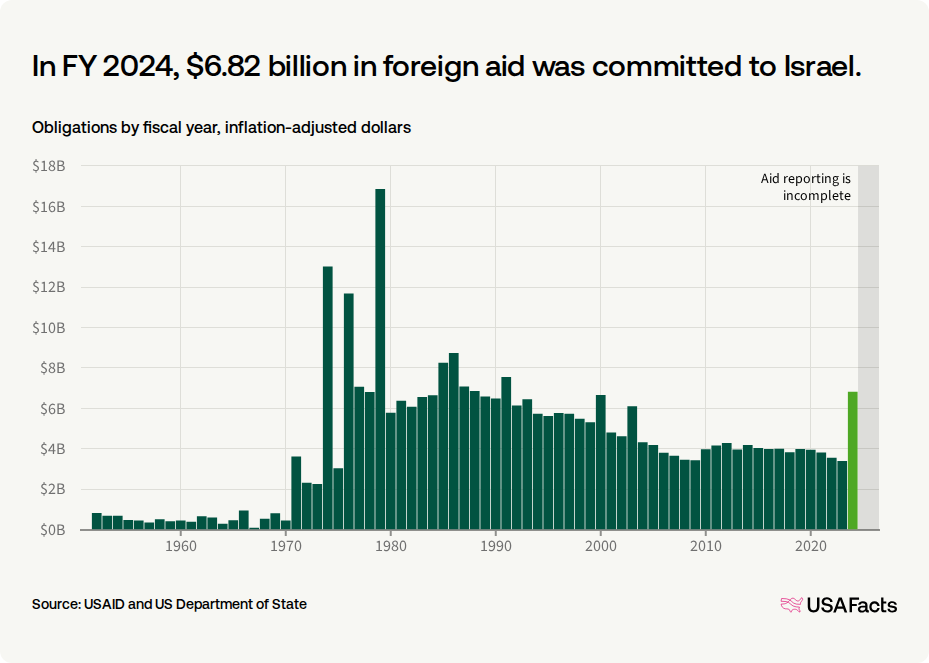
^USAFacts (accessed 19 Jan 2026).
Council on Foreign Relations
CFR reports $330 billion in total US aid to Israel as of 2024, including $244 billion in military aid and $86 billion in economic aid (in constant 2024 dollars).
This is a considerably better estimate than the one above because CFR bothered to include missile aid. However, in the notes section of their graph, CFR says it started counting missile funding in 2006. Why? Pentagon funding for Israel’s Arrow program dates back to the $52 million included in the 1990 military spending bill. Excluding missile aid from 1990–2005 means CFR’s estimate is $2.3 billion6 lower than it otherwise would be.
CFR has a $100 million annual budget.
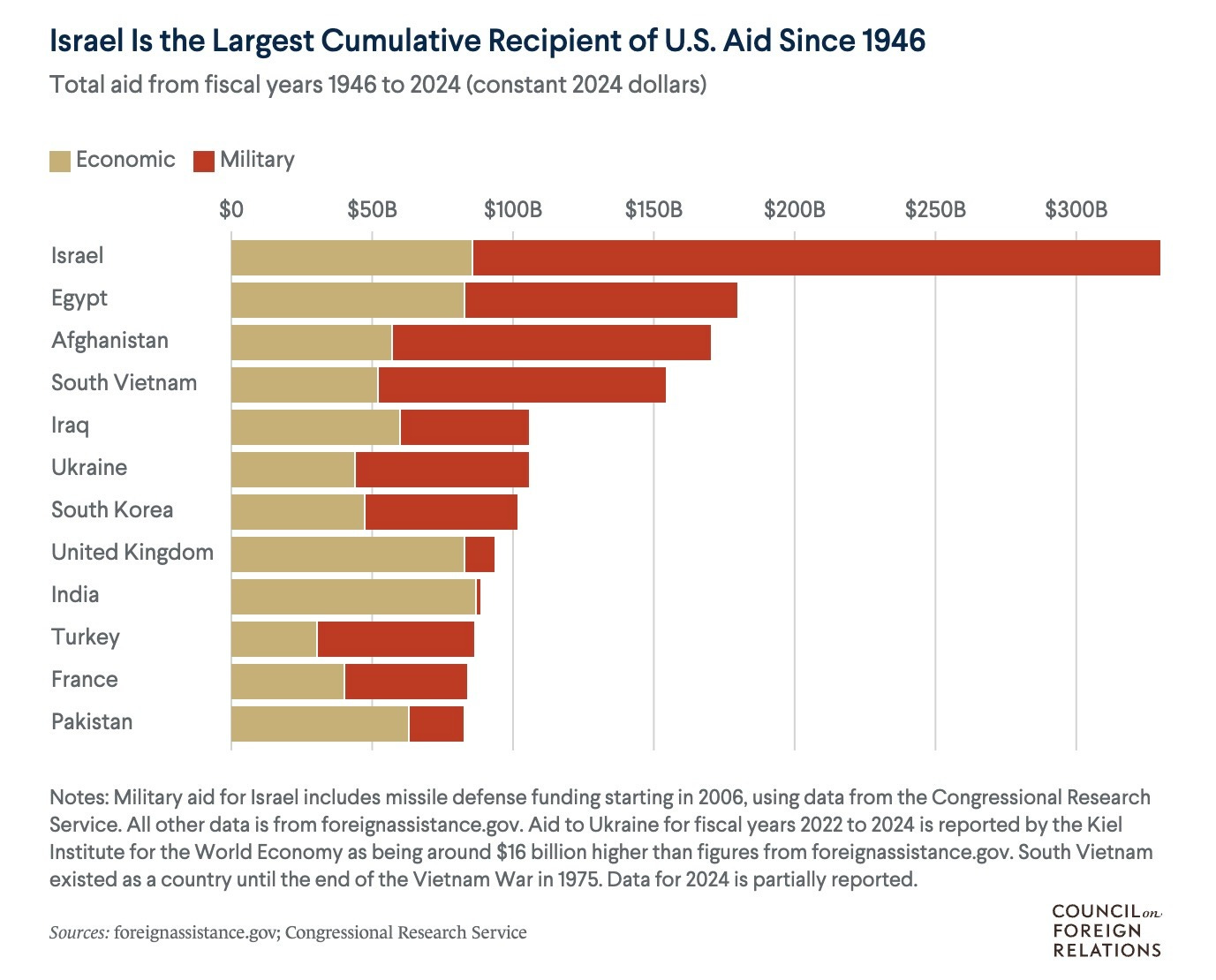
^CFR (accessed 19 Jan 2026)
Congressional Research Service
The best estimate so far. Not only does CRS include missile aid data in full, it collected all that data for us in the first place. The report containing its estimate is the single best resource on US aid to Israel; it even cites an article written by your boy.
The table below summarizes its tally. It’s slightly inconvenient that there’s no year-by-year breakdown or an inflation-adjusted total, making it all the more annoying that USAFacts and CFR set out to do those things and failed. Not a big deal.
I have questions, though. For example, why does its military aid count for 2021–25 omit funding for the Pentagon’s tunnel, drone, and emerging technology aid programs? What about the Excess Defense Articles program (discussed below)? More confounding is that CRS mentions all those programs in its report, and even itemizes annual funding levels for some of them.
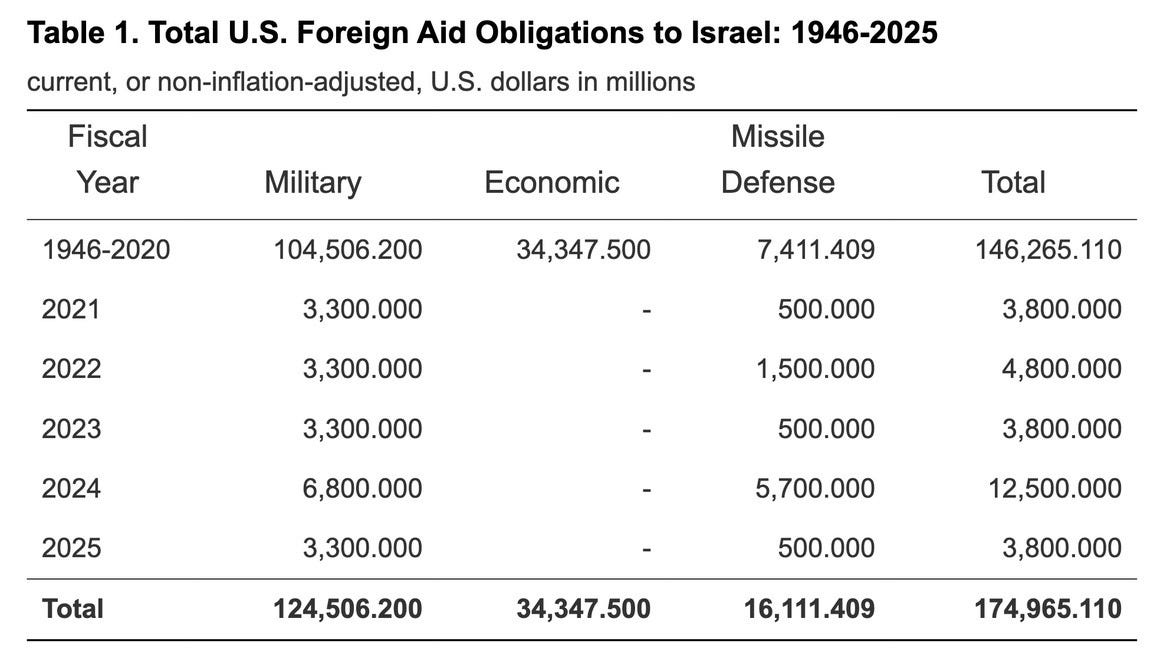
^CRS (accessed 19 Jan 2026)
Polygraph
My estimate is 2% higher than CRS’s: $5.2 billion more in nominal terms or about $7 billion more in constant 2025 dollars.7 This 2% mostly comes from resolving a discrepancy between how much aid the State Department said went to Israel through a certain military aid program versus how much aid for that program appears in the State Department’s database (ForeignAssistance.gov).
The program in question is the Excess Defense Articles (EDA) program. It’s essentially the international equivalent of the 1033 program, through which the Pentagon sends matériel it deems excess to police for free. EDA does the same thing for foreign countries. CRS notes that Israel has received $6.6 billion worth of matériel through the EDA program. However, less than a sixth of that amount appears in State-USAID data, which means less than a sixth of the funding is represented in the military aid totals of USAFacts, CFR, and CRS.
The problem is that the government says one thing, but its data shows another. I solved this problem using a FOIA request published by the Data Liberation Project, which shows complete EDA data for 1993–2023. It reveals unreported data that account for the discrepancy between the State Department’s official number on the value EDA transfers to Israel and the sum of the figures in its database.8
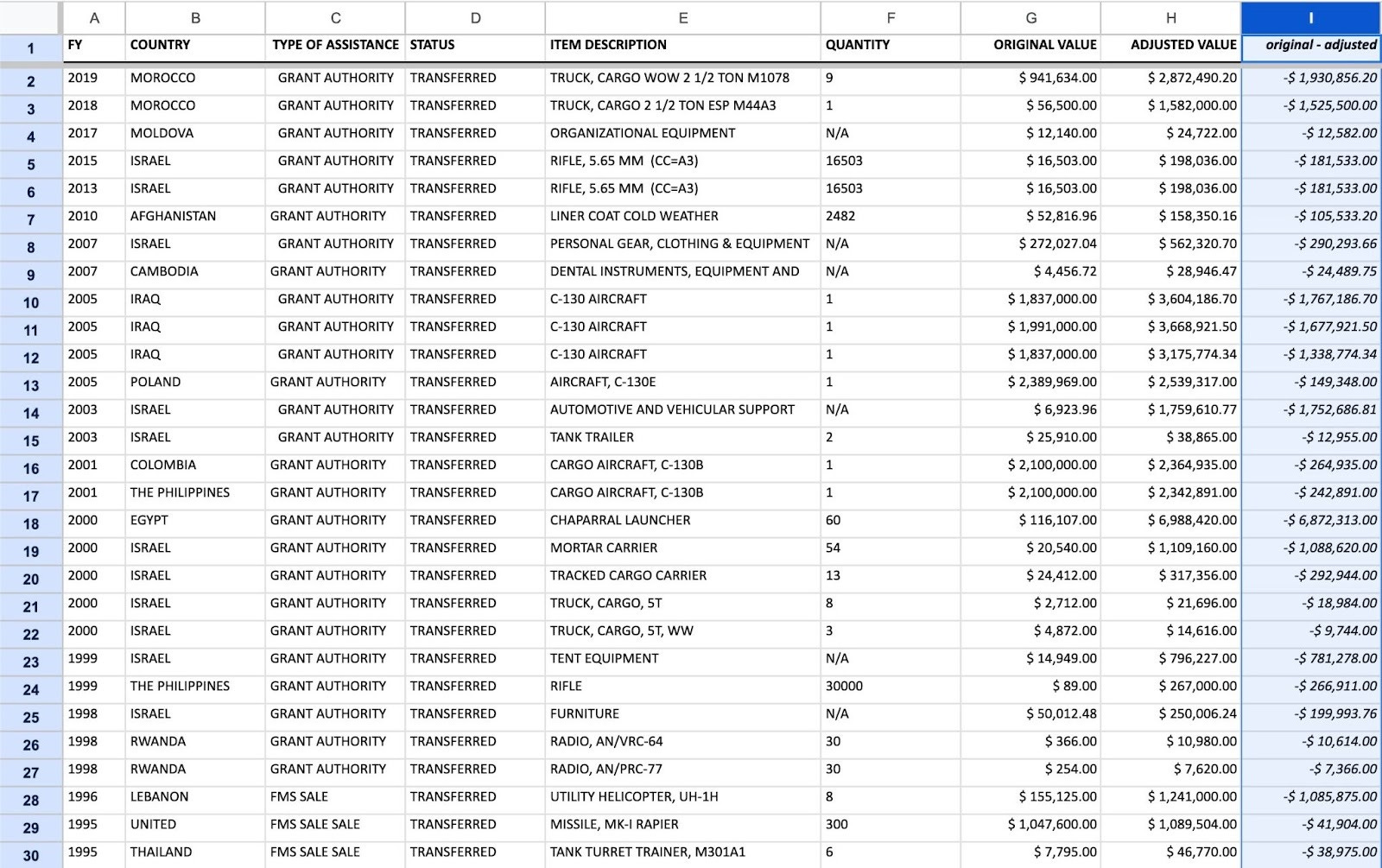
The discrepancy comes down to how the value of arms transferred through the EDA program are counted. The Pentagon’s own EDA dataset (which only goes back to 2013) lists two values for each item transferred through the EDA program: the original cost and an adjusted cost. The original cost is the item’s acquisition value, i.e., how much the US government originally paid for the thing. The adjusted cost is between 5% and 50% of the original cost. The State Department’s official number refers to original cost, but for whatever reason, only the adjusted costs are tallied on ForeignAssistance.gov.
The adjusted value is only there for the rare instances of an EDA sale, and is irrelevant when the item is given away for free, which for Israel is 99.7% of the time. Only 9 of 3,426 EDA transfers to Israel from 1993–2023 were sales. (I threw out those 9 cases for this study.)
The value of transfers through the 1033 program — the domestic equivalent of the EDA program — are recorded by original acquisition cost. For several reasons, I believe that this is the most accurate way to track EDA transfers too. The administration agrees: a State Department fact sheet from April 2025 states, “Since 1992, the United States has provided Israel with $6.6 billion worth of equipment under the Excess Defense Articles program, including weapons, spare parts, weapons, and simulators.” If the State Department understood the value of EDA transfers in terms of their adjusted costs, it would’ve said $1 billion, not $6.6 billion. Using the FOIA data, I counted $6,562,489,557 for the aggregate original value of EDA transfers to Israel from 1992–2024 (constant 2025 dollars), which rounds to the State Department’s official figure.
The FOIA request provides EDA data for 1993–2023. My graph includes estimated EDA data for 1990–92 and 2024–25. A 1994 GAO report provided EDA data for 1990–92 as a lump sum ($454,583,000). I divided that amount evenly across those three years ($151,527,667), before adjusting for inflation. For 2024, I estimated $83,694,574 based on the $14,555,578 in adjusted value reported for 2024 on ForeignAssistance.gov multiplied by 5.75, the average ratio of original to adjusted value from 1990–2023. For 2025, I estimated $137,343,797, based on the average acquisition value of transfers from 1990–2023.
*NB: A previous version misstated Israel’s GDP per capita compared to US states. That sentence has been removed.
SPECIAL THANKS TO: Abe B., Alan F., Alissa Q., Amin, Andrew R., AT., B. Kelly, Bart B., BeepBoop, Ben, Ben C.,* Bill S., Bob N., Brett S., Byron D., Carol V., Catherine L., Chris, Chris G., Cole H., Coleman J., D. Kepler, Daniel M., Dave, David J., David S.,* David V.,* David M., Dharna N., Elizabeth R., Emily H.,* Errol S., Foundart, Francis M., Frank R., Fred R., Gary W., Gladwyn S., Graham P., Griffin R., Hunter S., IBL, Irene B., Isaac, Isaac L., Jacob, James G., James H., James N., Jamie LR., Jcowens, Jeff, Jennifer, Jennifer J., Jessica S., Jerry S., Joe R., John, John, John A., John K., John M., Jonathan S., Joseph B., Joshua R., Julia G., Julian L., Katrina H., Keith B., Kheng L., Lea S., Leah A., Leila CL., Lenore B., Linda B., Linda H., Lindsay, Lindsay S.,* Lora L., Mapraputa, Marie R., Mark L., Mark G., Marvin B., Mary Z., Marty, Matthew H.,* Megan., Melanie B., Michael S., Mitchell P., Nick B., Noah K., Norbert H., Omar A., Omar D.,* Peter M., Phil, Philip L., Ron C., Rosemary K., Sari G., Scarlet, Scott H., Silversurfer, Soh, Springseep, Stan C., TBE, Teddie G., Theresa A., Themadking, Tim C., Timbuk T., Tony L., Tony T., Tyler M., Victor S., Wayne H., William H.,* William P.
* = founding member
-Stephen (Follow me on Instagram, Twitter, and Bluesky)
Israel will also receive (relatively) small amounts of military aid through the INCLE and NADR “security assistance” programs, which are also funded by the State Department, but aren’t earmarked for specific countries in its annual funding bill. Obligated amounts for these programs are disclosed through ForeignAssistance.gov.
Refugees have the right of return. Israel denies Palestinian refugees that fundamental human right.
GAO (1993): “The [Pentagon] has no operational requirement for the Arrow missile and has no plans to buy it.”
Constant FY2025 dollars, adjusted using the GDP deflator.
In constant 2024 dollars, to match their figures.
In constant 2024 dollars, to match their figures.
It’s difficult to adjust for inflation given the lack of yearly CRS data outside of 2021–25; $7 billion is a conservative estimate.
If anyone from DLP is reading this: Thank you for your terrific work. Also, there are several instances of the Pentagon recording the original value in the adjusted value column, and vice-versa, evidenced by the instances in which the adjusted value is higher than the original (which should never be the case for EDA transfers). These mistakes are present in the source PDF, i.e., they’re not your fault. Happy to talk more.
Since ‘51 the pentagon has spent 17- $20T with more than half going to contractors after Afghanistan?