
US spent $103 billion on the Iran War in four months
Polygraph | Newsletter n°345 | 13 Jul 2026

IN THIS NEWSLETTER: A summary of my new Iran War cost estimate, and why it differs so sharply from prevailing estimates.
*Thank you, Daniel M., for becoming a paid subscriber! Please join Dan and the others thanked at the bottom of each newsletter to support my work.
How much has the US spent on the Iran War?
The US spent more than $103 billion in the first four months of the Iran War, according to my new article, “The real cost of the Iran War: $103 billion in 120 days,” for Popular Information.
My May 6 cost estimate for the war’s first 60 days — also published by Popular Information — was covered by independent media, featured by the nonpartisan Taxpayers for Common Sense, and cited in a May 27 letter from 20 Senate Democrats to the Congressional Budget Office. No other cost estimate came closer to the amount Trump later requested for the initial phase of the war. Pentagon officials said $25 billion–29 billion; think tanks estimated $26 billion–40 billion; my May estimate put the war’s cost at $71.8 billion. In June, Trump requested $72 billion for war costs.
But that estimate was just for the war’s first two months, and Trump’s request wasn’t designed to cover its entire cost — the administration plans to finance additional expenses through another reconciliation bill. Hence my new 120-day cost assessment.
This table gives an overview of the estimated $103 billion the US spent on the Iran War from February 28 to June 27, 2026. (A far more granular breakdown of the direct costs can be found in the methodology section of the article.) Note that this total refers only to direct war costs — the near-term budgetary costs directly tied to the war, including operations, personnel, and matériel — and not indirect costs, which refer to broader budgetary and economic costs like veterans care and inflation. Below the table is an explanation for why my estimate is $65 billion higher than the prevailing non-government estimate.
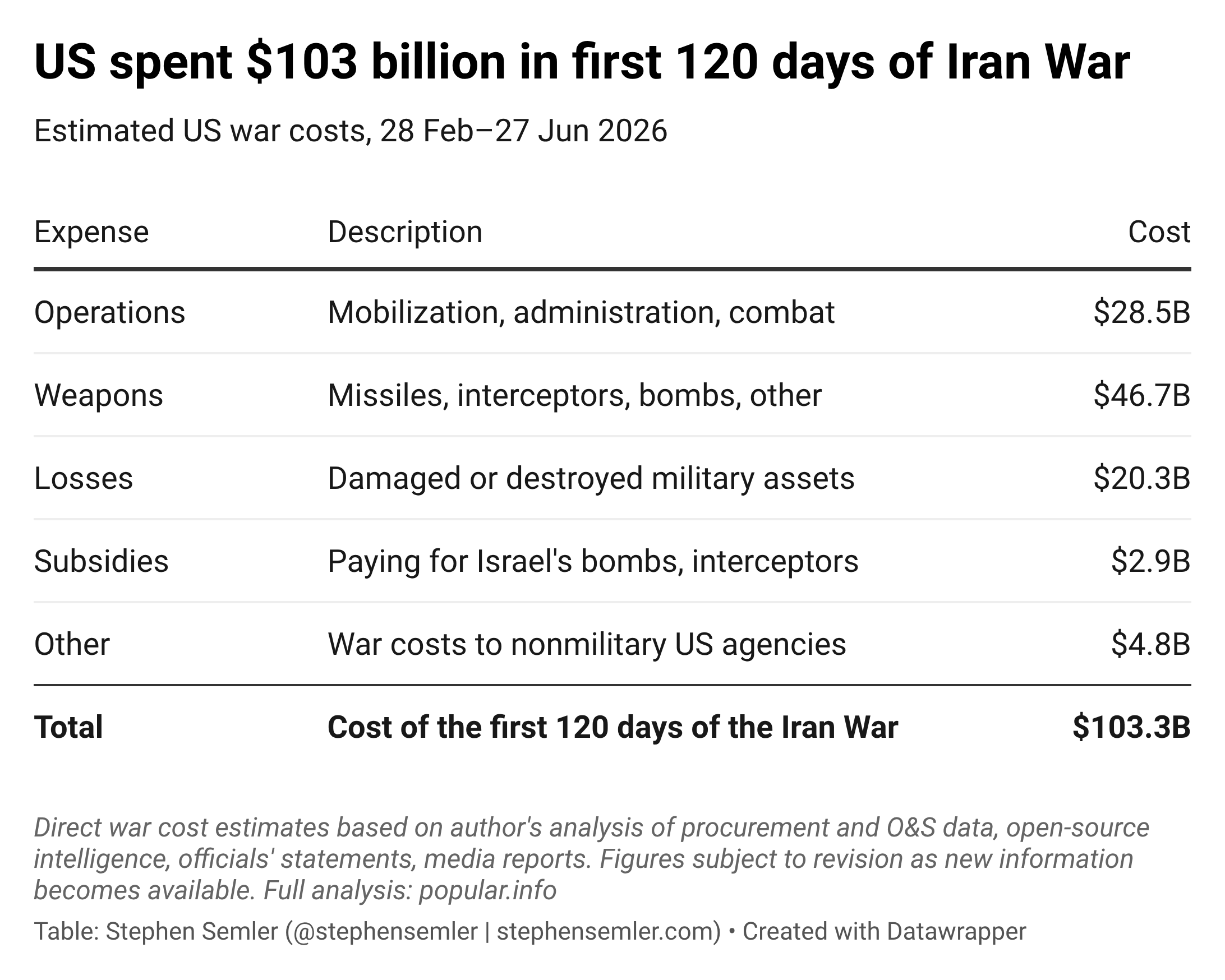
^Source. Alt text for screen readers: US spent $103 billion in first 120 days of Iran War. Estimated US war costs, February 28 to June 27, 2026, in billions of dollars. Operations (mobilization, administration, combat), 28.5; Weapons (missiles, interceptors, bombs, other), 46.7; Losses (damaged or destroyed military assets), 20.3; Subsidies (paying for Israel’s bombs, interceptors), 2.9; Other (war costs to nonmilitary US agencies), 4.8. Total cost of the first 120 days of the Iran War: 103.3. Direct war cost estimates based on author’s analysis of procurement and O&S data, open-source intelligence, officials’ statements, media reports. Figures subject to revision as new information becomes available.
Why you should trust this estimate
Let’s agree to establish the following standard: Cost estimates for the Iran War should be mostly right or at least respectably wrong, and their methodologies transparent enough for readers to make that determination for themselves.
The analysis and methodology behind the table above lend credibility to the estimate, because they show where all the numbers came from and why they’re there.1
Three of the most popular sources of war cost estimates have not met that standard.
Trump administration officials, who have become increasingly brazen in lying about the war’s cost. A recent, parody-level example: on June 30, the Trump administration’s budget director, Russell Vought, told the House Appropriations oversight subcommittee that the Iran War had cost $30 billion — less than a week after Vought himself wrote to the House Speaker requesting $72 billion for war costs.
AI cost trackers, which dress up an arbitrary and capricious methodology with an air of technological sophistication, leading some to mistake the outputs as credible data. At least when Trump administration officials lie you’ve got someone to be mad at; AI cost trackers spread disinformation without authorship, thereby removing any possibility of accountability.
Establishment think tanks, which possess more than enough technical expertise to produce a proper comprehensive cost assessment of the Iran War, but don’t due to competing ideological or financial factors. A comparison between the most recent estimate from the Center for Strategic and International Studies (CSIS) and my own is discussed below.
On June 23, CSIS estimated that the Iran War had cost “around $40 billion,” roughly on par with estimates from other prominent Washington, DC-based think tanks. The CSIS table below provides an overview.
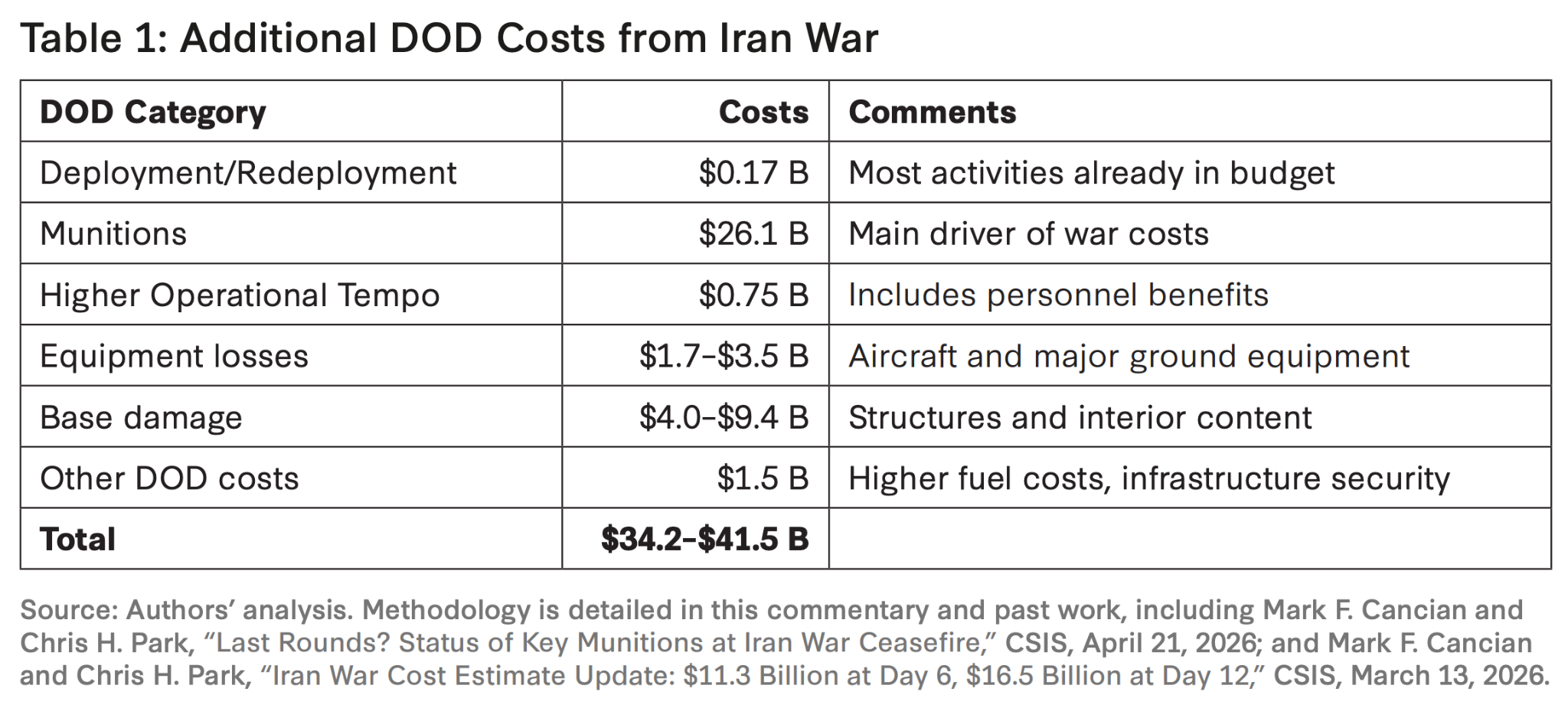
The single largest discrepancy between the CSIS estimate and my own is the amount for operations: I said $28.5 billion; CSIS said $755 million, claiming the Iran War’s operational costs “were not large because most of these costs were already in the budget.”2
Clearly there is some disagreement over how to calculate the war’s incremental costs — the costs that would not have been incurred if not for the war. But there can be no disagreement over which estimate is out of sync with reality.
On June 24, a day after CSIS published its June estimate, the White House requested at least $21 billion for “operational costs incurred by the Department of War during [the Iran War],”3 including:
“$17.3 billion for operational costs”
“$1.7 billion for readiness” (“readiness” is primarily funded through the Pentagon’s Operation & Maintenance (O&M) account)
“$1.5 billion for fuel costs” (military branches use their O&M budgets to purchase fuel)
CSIS downplayed the war’s operational costs by claiming they were already funded. Trump administration officials did the same thing during congressional hearings in April and May, only to reveal tens of billions of dollars in “urgent” [read: unbudgeted] operational war costs in June. As I noted in April, there’s a vast difference between what officials say the war costs and how much they’ll ultimately ask the public to pay for it.
The article should end here. But analyzing CSIS’s estimate reveals a scandal: it only selectively applies the methodology that dramatically understates war costs.
In Trump’s supplemental funding request, there’s at least $21 billion for operations (itemized above) and at least “$21 billion for munitions.” For operations, CSIS’s estimate was at least $20 billion lower by comparison. But for munitions, CSIS’s estimate was $5 billion higher.
CSIS waved off nearly all operational costs on the grounds that they were already budgeted for, but claimed that the expended missiles and bombs were not, thereby requiring supplemental funding to replace them — on top of the munitions already purchased through this year’s military budget.4
There’s no empirical rationale for this inconsistency. For example, the Pentagon reprogrammed $8 billion in operations funding last June for the 12-day war — a war of a far lower scale, intensity, and duration than this year’s. The forces surged to the Middle East and Europe for the 2025 war were steadily drawn down until the historic buildup ahead of this year’s conflict. On the munitions side, the 2026 budget dramatically increased the number of munitions eventually fired during this year’s war. For example, 194 Patriot interceptors were purchased in 2025 but 310 in 2026, excluding the additional Patriot interceptors procured this year using reconciliation (mandatory) funds.
If CSIS was planning to wave off costs on the presumption that they were already budgeted for, they should have at least done so consistently, meaning for both operations and munitions. They would have still been wrong, but at least consistently wrong.5
How arms industry funding influences national security “expertise”
If you’re a major Pentagon contractor, what type of content would you want the think tank you’re donating to to produce right now? Your demands — which you would never have to say out loud if you’re donating enough money — would likely be as follows:
Restrict your criticism of the Iran War to its depletion of munition stockpiles needed to fight the next war.
Tally munition expenditures and by all means make your war cost estimate plausible, but understate the total cost.
As an arms company, you want to draw attention to the number of munitions the US is expending to create demand for the replacements you sell. But you don’t necessarily want to draw attention to the spiraling cost of the war itself: a war cost estimate that attracts press attention risks making a historically unpopular war even more unpopular. Mounting public opposition not only threatens the longevity of this highly profitable war but also the passage of the annual Pentagon budget, 54% of which goes to Pentagon contractors. The share of Americans who support decreasing military spending has already grown from 40% in 2025 to 55% in 2026.
CSIS ranks third among all think tanks in accepted donations from Pentagon contractors. Its top donors include Northrop Grumman, General Atomics, General Dynamics, and Lockheed Martin, maker of the THAAD and Patriot missile defense systems. The US has fired more than 1,300 Patriot interceptors during the Iran War.
These donations matter. One study analyzing think tanks and donations from military contractors found that “such stakeholder funding has real effects on intellectual freedom. Given the widely-held view that democracy relies on intellectual independence, this finding calls for a serious debate about conflicts of interest in foreign policy analysis.”
Let’s revisit those two demands you made earlier as a hypothetical arms company donor to your think tank donee:
Restrict your criticism of the Iran War to its depletion of munition stockpiles needed to fight the next war (e.g., see CSIS, “Last Rounds? Status of Key Munitions at the Iran War Ceasefire,” 21 Apr 2026).
Tally munition expenditures and by all means make your war cost estimate plausible, but understate the total cost (e.g., see CSIS, “The War May Be Ending. What Did Epic Fury Cost?,” 23 Jun 2026).
I’m not making character judgements about the authors of the CSIS estimate. I don’t know them, their motivations, or their circumstances. But the fact of the matter is that an arms industry-funded think tank produced exactly the type of content that benefits arms companies. CSIS simultaneously sounded an alarm over the US’s rapid consumption of costly munitions and dwindling stockpiles — thereby fomenting demand for replacing them with newer, costlier munitions — while downplaying the cost of the overall war.
The cost of war is a serious matter. War cost estimates should be mostly right, or at least respectably wrong. Do you think the CSIS estimate meets this standard, or do you think it falls into the third, “disreputably wrong” category? And do you think CSIS, as a top think tank recipient of arms industry cash, really cares what you think?
Still better than those AI war cost trackers, though.
SPECIAL THANKS TO: Abe B., Alan F., Alexander L., Alissa Q., Amin, Andrew R., AT., B. Kelly, Barbara B., Bart B., BeepBoop, Ben, Ben C.,* Bill S., Bob N., Brett S., Byron D., Carol V., Catherine L., Chris, Chris G., Claudia, Cole H., Coleman J., D. Kepler, Daniel M., Dave, David J., David S.,* David V.,* David M., Dharna N., Elizabeth R., Emily H.,* Errol S., Ethan R., Foundart, Fran Q., Francis M., Frank R., Fred R., Gary W., Gladwyn S., Graham P., Griffin R., Heath P., Hunter S., IBL, Irene B., Isaac, Isaac L., Jacob, James G., James H., James N., Jamie LR., Jcowens, Jeff, Jennifer, Jennifer J., Jessica S., Jerry S., Joe R., John, John, John A., John K., John M., Jonathan S., Joseph B., Joshua R., Julia G., Julian L., Katrina H., Keith B., Kesh L., Kheng L., Lea S., Leah A., Leila CL., Lenore B., Linda B., Linda H., Lindsay, Lindsay S.,* Lora L., Lou B., Mapraputa, Marie R., Mark L., Mark G., Marvin B., Mary Z., Marty, Matthew H.,* Megan., Melanie B., Michael S., Mitchell P., Nick B., Noah K., Norbert H., Omar A., Omar D.,* Peter M., Phil, Philip L., Ron C., Rosemary K., Sari G., Scarlet, Scott H., Silversurfer, Soh, Springseep, Stan C., TBE, Teddie G., Theresa A., Themadking, Tim C., Timbuk T., Tom B., Tony L., Tony T., Troy, Tyler M., Victor S., Viviane A., Wayne H., William H.,* William P.
* = founding member
-Stephen (Follow me on Instagram, Twitter, and Bluesky)
This is a habit I picked up from contributing to some of the most rigorous and authoritative war cost studies published over the last few years, and from writing this newsletter — Polygraph VIPs are a critical bunch in the best possible way.
Would CSIS conclude that the Iran War cost zero dollars if the conflict was entirely budgeted for? Surely the authors must draw the line somewhere.
In addition to the three listed below, several other provisions in the supplemental funding request could also include operational costs (e.g., “$12.1 billion for other classified programs,” “$1.2 billion for Administration priorities,” “$0.8 billion for National Guard support,” etc.)
To be sure, I think CSIS vastly underestimated the munition expenses, too. But here they were at least respectably wrong. Their methodology makes sense — mostly, from what parts of it are disclosed — though I’m not entirely sure where many of their numbers come from. There also appears to be a lack of attention to detail in some cases. For example, CSIS Table 2 lists “150–380” for the combined number of US-fired Precision Strike Missile (PrSM) and Army Tactical Missile System (ATACMS) surface-to-surface missiles, when the Times reported that the Pentagon had used more than 1,000 by mid-April. Just because the Times reported it doesn’t make it true, but CSIS munition counts are largely based on reporting from the Times and other media outlets that report on munition expenditures. Mine are too.
CSIS puts the cost to replace each expended PrSM and ATACMS at $1.6 million (PrSM replaces ATACMS, so they have the same unit replacement cost), which presumably refers to the unit flyway cost budgeted for 2027 (total flyaway cost: $1,081,438,000 / quantity: 664 = $1,628,672). But that’s based only on the PrSM Increment 1 variant, not the considerably more expensive Increment 2. Far fewer of the latter variety are budgeted for 2027, but pretending none are leaves your unit cost about $140,000 lower than it should be (total flyaway cost, Increment 1 + 2: 1,202,362,000 / quantity, Increment 1 + 2: 680 = $1,768,179).
These oversights on cost and quantity left at least $1.3 billion on the table.
Perhaps even respectably wrong. For its part, the Trump administration appears to be consistent with its funding strategy: fund a portion of its war costs through a supplemental bill and dump others to next year’s standard budget and reconciliation bill. This is the case for munitions especially. For example, one of the most expensive and frequently-expended munitions during the Iran War has been the THAAD. Not only is there a massive uptick in the number of THAAD interceptors produced in the standard military procurement budget (discretionary spending), the Trump administration plans to buy even more of them through another reconciliation bill (mandatory spending). Per a 2027 Army procurement document: “The FY 2027 request for Thermal High Altitude Area Defense (THAAD) includes $907,162 thousand of discretionary and $10,528,043 thousand of mandatory for a total of $11,435,205 thousand. The mandatory funds for THAAD procures 830 THAAD missiles.”