
Why “affordability” suddenly matters in Washington
Polygraph | Newsletter n°324 | 3 Dec 2025

IN THIS NEWSLETTER: Voters have ranked affordability as their top concern for years, but only recently has it captured Washington’s attention. Here’s why.
*ICYMI: How Trump’s trillion-dollar war machine enriches the 1%
Please read and share with your representative and senators.
*Latest post for Polygraph VIPs: Trump: No economic hardship, just bad vibes
*Many thanks to Emily H. for becoming a paid subscriber — Polygraph continues to attract the support of the very finest folks. Grateful for you all.
Situation
In November, voters ranked economic insecurity as their top concern — just as they did in each of the 40 months before that.
YouGov runs a recurring survey asking Americans what they believe is the most important issue facing the country.1 “Inflation/prices” was first listed as an option in July 2022, and it’s been the most popular selection in 168 of the 171 near-weekly polls conducted since. (It was the second-most popular response the three times it wasn’t the most popular.2) Average the near-weekly data out into months and affordability has been voters’ number one issue for 41 consecutive months.3
Economic security refers to one’s ability to reliably make ends meet. Being secure in this way means having the resources to make ends meet now and feeling comfortable that you’ll have the resources to do so in the future. This forward-looking dimension is part of any definition of security because the concept itself is future-oriented: it implies continuous protection against a given threat, a preservation of well-being, both now and extending into the future.4 “Inflation/prices” expresses economic security as a poll question by capturing the relevant concerns related to both the present (high prices) and future (rising prices).
“Affordability” has emerged as the trendy synonym for economic security, though the latter’s still quite common. It’s used in describing the problem (“lack of affordability”), the scale of the problem (“affordability crisis”), and policy platforms centered on fixing the problem (“affordability agenda”). The term’s everywhere now.
And it’s about time. The chart below lists the six most popular responses to the YouGov poll from January 2021 to November 2025, and shows the percentage of Americans who ranked each as the most important issue. Five are very salient issues. Then there’s economic insecurity — affordability — which is the issue. Since mid-2022, more than one in five Americans have said it’s their top concern.5
To give you an idea of how salient the next five most popular concerns are, notice how prominent issues like abortion, crime, gun control, foreign policy, and taxes aren’t there instead. This makes it all the more remarkable that affordability has topped all of them for 41 straight months, and that it’s taken the media and Washington almost as long to decide that the affordability crisis is headline-worthy.
What led to affordability’s political breakthrough?
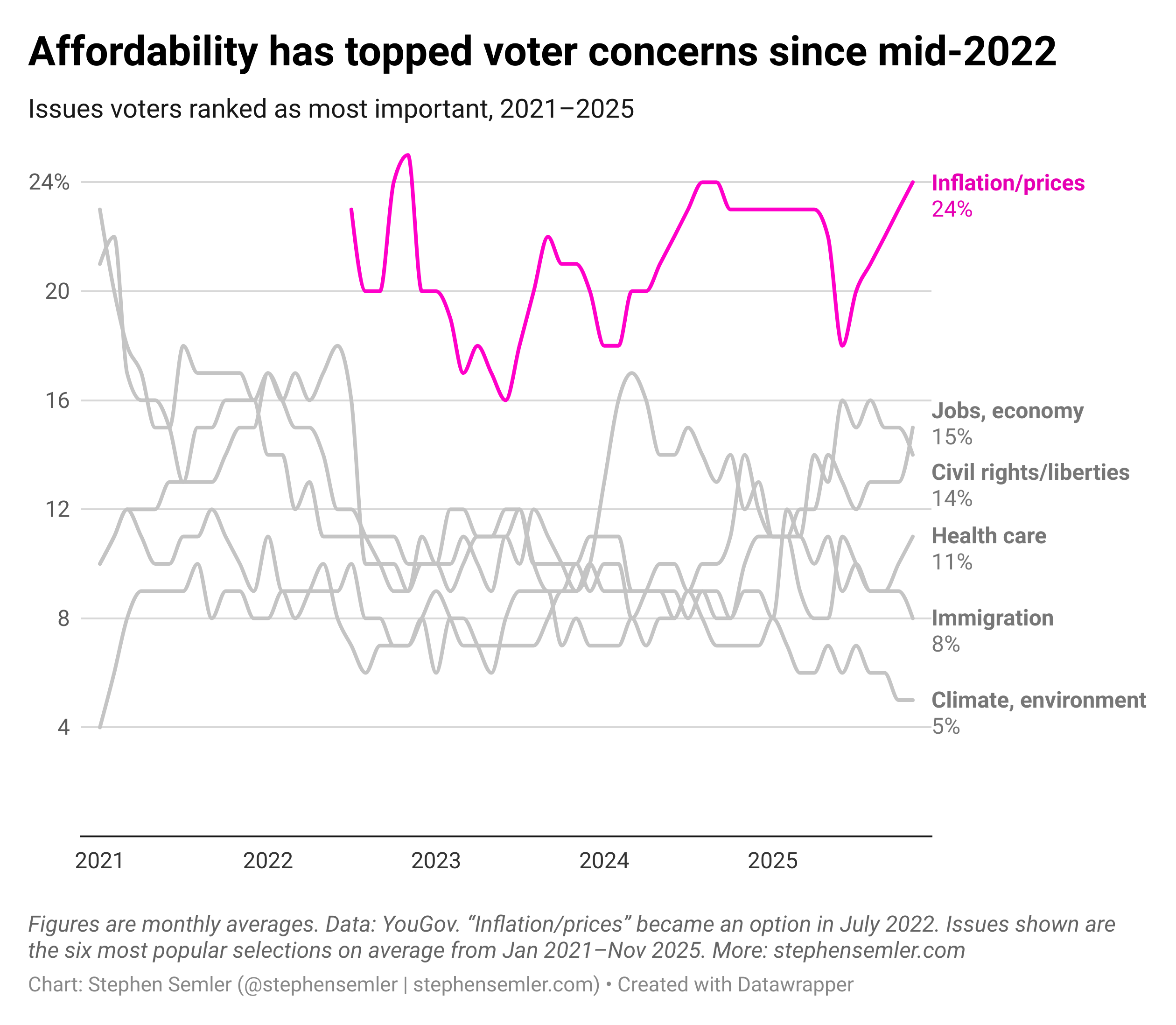
^Alt text for screen readers: Affordability has topped voter concerns since mid-2022. Issues voters ranked as most important, 2021 to 2025. “Inflation/prices” has remained the most popular response every month since July 2022. Figures are monthly averages. Data: YouGov. “Inflation/prices” became an option in July 2022. Issues shown are the six most popular selections on average from January 2021 to November 2025. Other issues listed: “jobs, economy” “civil rights/liberties” “health care” “immigration” “climate, environment.”
*NB: For a more nuanced look at the data, I added an interactive version of the graph at the bottom of this newsletter. Or you can access YouGov’s survey data directly to see the data on all polled issues.
What led to affordability’s political breakthrough
Longtime Polygraph readers know that I haven’t shut up about the economic (and food) security crisis since mid-2023, so it’s surreal seeing “affordability crisis” suddenly all over the headlines in late 2025.
I attribute affordability’s breakthrough in Washington to two things: 1) voters punishing out-of-touch parties and politicians; and 2) voters supporting candidates who challenge the political establishment.
1. Voters punishing out-of-touch parties, politicians
If voters had no problem affording increasingly high costs, they wouldn’t rank it as their top concern. But since they do, they do. High prices harm people’s current well-being, and rising prices threaten their future well-being. There is plenty of data on economic insecurity to back this up.
For example, only about a third of Americans live comfortably financially, according to the Federal Reserve, and more than four in ten have difficulty paying their bills, according to the Consumer Financial Protection Bureau. Data from the most recent five-year period from each of these surveys are shown in the graph below.6
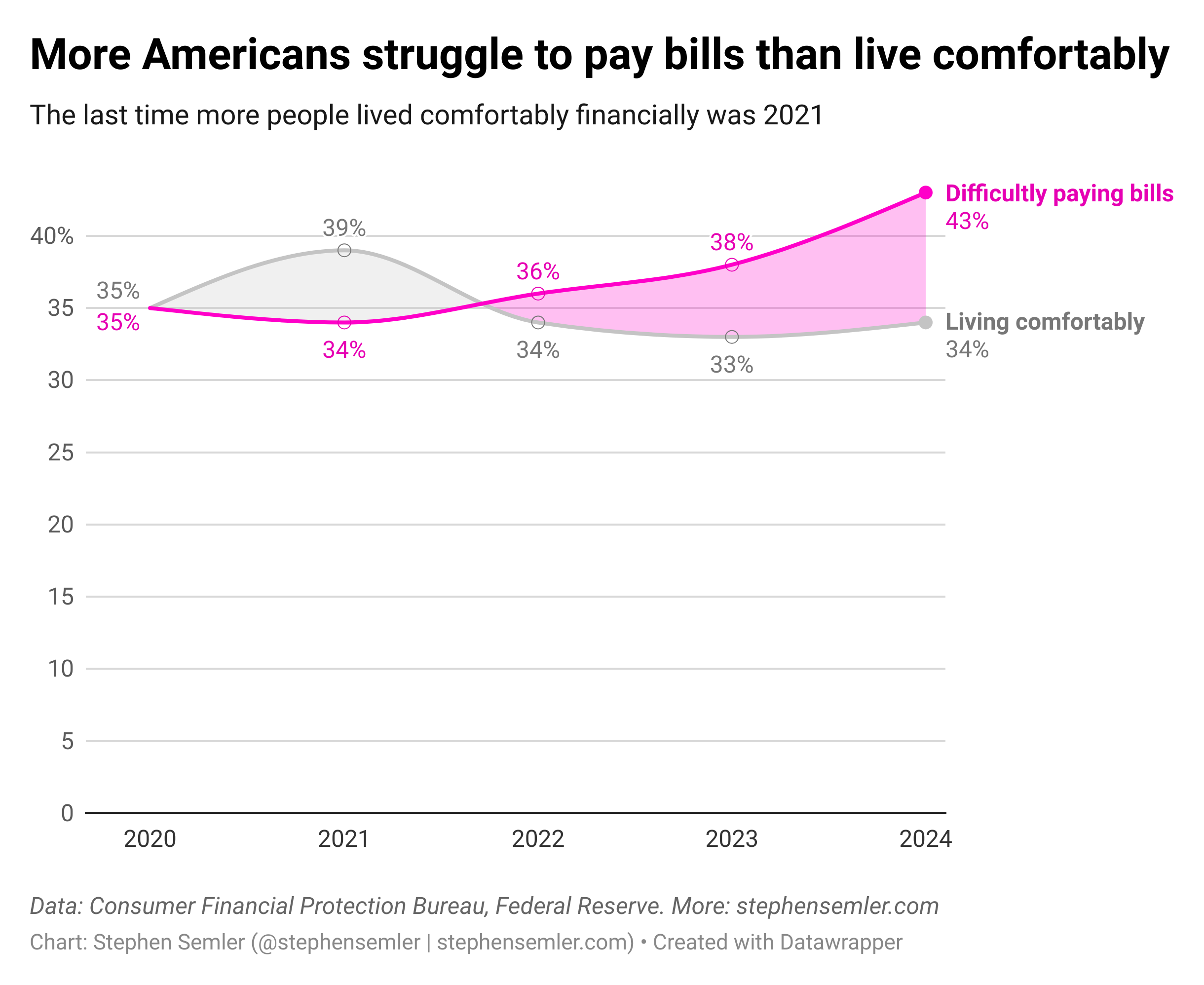
^Alt text for screen readers: More Americans struggle to pay bills than live comfortably. The last time more people lived comfortably financially was 2021. This chart shows the percentage of Americans having difficulty paying the bills from 2020 to 2024 (35, 34, 36, 38, 43) and living comfortably (35, 39, 34, 33, 34).
Despite the abundance of economic insecurity data signaling a crisis, there is a popular — though not for much longer — narrative that insists there’s no substance behind widespread economic negativity, it’s just bad “vibes.” And because it’s bad vibes and nothing more, no policy changes are needed, just better marketing.
Empirically, there’s so much wrong with the “vibecession” narrative that even articles written by its top preachers can be swiftly rebuked in a footnote. It’s also as condescending as you’d expect. Here’s self-described vibes guy Paul Krugman writing in the New York Times in late 2023:
Biden administration officials are trying hard to sell their economic accomplishments, as they should — if they don’t, who will? But will public opinion turn around? Nobody knows. We’re living in a world in which what people believe may have little to do with facts, including the facts of their own lives.
Biden, and later Harris, chose the vibes-guy approach. Here’s something I wrote about Democrats in August 2023:
They’ve certainly got the right to brag about high GDP, low unemployment, and generally-improving inflation numbers. But these numbers don’t reflect the conditions of day-to-day economic life. And those conditions are demonstrably poor. While Republicans don’t have a credible plan to fix things like food or financial insecurity, they’ve still managed to outdo Democrats, who seem to have unanimously agreed to not mention this problem at all. By insisting everything’s fine when it isn’t, Democrats risk coming off as the most annoying people on the planet to millions of voters who wouldn’t otherwise think so.
In November 2024, the electorate delivered a middle finger to an irritatingly out-of-touch incumbent party: While the share of US voters unhappy with economic conditions increased by 18 percentage points from 2020 to 2024, the percentage of those who backed the Democratic candidate fell by 52 points.7
Being a vibes guy ultimately amounts to telling voters they’re fine when they’re not. People hate that, and are generally eager to punish you for it. There might not be a more politically poisonous narrative than the “vibecession”: Democrats embraced it in 2024 and lost. Republicans embraced it in 2025 and lost, and will likely lose the 2026 midterms for the same reason.
Donald Trump is a vibes guy. In a recent Fox News interview, Trump rejected widespread reports of economic insecurity. Here are a couple excerpts:
Ingraham: “Is this a voter perception issue of the economy, or is there more that needs to be done by Republicans on Capitol Hill in terms of policy?”
Trump: “More than anything else, it’s a con job by the Democrats. They just…put out something, say today, costs are up. They feed it to the anchors of ABC, CBS, and NBC…Costs are way down.”
[...]
Ingraham: “So are you saying that voters are misperceiving how they feel? Because you said Biden did that…[Biden] was saying things were great…Why are people saying they’re anxious about the economy?”
Trump: “I don’t know that they are saying that. I think polls are fake. We have the greatest economy we’ve ever had.”
This was a really bad look, particularly because Trump won a lot of votes by campaigning on lowering costs and constantly slamming the Biden-Harris administration for price hikes. It was little surprise that CNN reported the following two days after the Fox News interview:
Trump’s advisers acknowledge that they have an affordability problem…Americans’ outlook on the economy is dour, and the administration’s efforts to ease their financial anxieties aren’t resonating.
“You can’t convince people that their experience, what they’re feeling at home, isn’t reality,” one of the officials said.
Trump reportedly called the affordability crisis a “fake narrative” and a “con job” by Democrats again this week. Too late — Republicans have already acknowledged the affordability crisis and publicly committed to addressing it. Last week, for example, a GOP senator published “A GOP Playbook for an Affordability Offensive” in the Wall Street Journal.
After taking turns denying its existence, Democrats and Republicans now recognize the existence of the affordability crisis at the same time. I think this marks the beginning of the end of the indiscriminately toxic “vibecession” narrative. The smart vibes guys will hedge their past takes (Krugman already has) or move on to something else. The dumb vibes guys won’t see the writing on the wall — they’ve got that special kind of antisocial arrogance, the type that leads one to conclude, All these women at this Whole Foods must be too shy to ask for my phone number, so I guess I’ll just start yelling it.
You won’t see me doing that.
2. Voters supporting challengers to the political establishment
Up until a few months ago, it looked like the Republican and Democratic parties were fine playing political table tennis with voters over affordability — capitalizing off each other’s negligence each election but not proposing to fix the problem once elected — and doing so indefinitely. Harris ignored voters’ number one issue in the 2024 election, Trump ignored it after he won, and establishment Democrats didn’t appear interested in addressing it in 2025 until Zohran Mamdani felled one of their own in the New York City mayoral elections (first in the primary then general election) by running on an affordability agenda.
Affordability is not something establishment politicians want to address because it risks shifting economic politics primarily from the national to human level. Such a shift would risk changing who politicians primarily make policy for: after all, legislating mainly for the sake of national economic growth isn’t the same as doing so mainly for human economic well-being. That would, in turn, risk changing who politicians are primarily accountable to. Instead of answering first to the small group of political and economic elites who define what’s in “the national interest,” more mind would have to be paid to the workers who actually make the economy go.
All this would require actually governing, which probably doesn’t sound so appealing for politicians who’ve made a career off ruling. This helps explain why an immense amount of campaign cash was invested by establishment Republicans and Democrats alike to stop Mamdani, and why the highest-ranking Democrat in office, Chuck Schumer (D-NY), refused to endorse him.
Unfortunately for the political establishment, people support ideas like a public option for groceries and voted accordingly. An affordability agenda speaks to their sense and lived reality of economic insecurity, which Republican and Democratic leadership have taken turns ignoring for the past 41 months.
SPECIAL THANKS TO: Abe B., Alan F., Alissa Q., Amin, Andrew R., AT., B. Kelly, BartB., BeepBoop, Ben, Ben C.,* Bill S., Bob N., Brett S., Byron D., Carol V., Chris, Chris G., Cole H., Coleman J., D. Kepler, Daniel M., Dave, David J., David S.,* David V.,* David M., Elizabeth R., Emily H.,* Errol S., Foundart, Francis M., Frank R., Gary W., Gladwyn S., Graham P., Griffin R., Hunter S., IBL, Irene B., Isaac, Isaac L., Jacob, James G., James H., James N., Jamie LR., Jcowens, Jeff, Jennifer, Jennifer J., Jessica S., Jerry S., Joe R., John, John, John A., John K., John M., Jonathan S., Joseph B., Joshua R., Julia G., Julian L., Katrina H., Keith B., Kheng L., Lea S., Leah A., Leila CL., Lenore B., Linda B., Linda H., Lindsay, Lindsay S.,* Lora L., Mapraputa, Marie R., Mark L., Mark G., Marvin B., Mary Z., Marty, Matthew H.,* Megan., Melanie B., Michael S., Mitchell P., Nick B., Noah K., Norbert H., Omar A., Omar D.,* Peter M., Phil, Philip L., Ron C., Rosemary K., Sari G., Scarlet, Scott H., Silversurfer, Soh, Springseep, Stan C., TBE, Teddie G., Theresa A., Themadking, Tim C., Timbuk T., Tony L., Tony T., Tyler M., Victor S., Wayne H., William P.
* = founding member
-Stephen (Follow me on Instagram, Twitter, and Bluesky)
Survey question: Which of these is the most important issue for you?
It was edged out by “immigration” by 2 percentage points for the 12 Feb 2024 poll, by “civil rights and civil liberties” by 2 points for the 16 Jun 2025 poll, and by 4 points for the 30 Jun 2025 poll.
I averaged these near-weekly data into months to smooth random fluctuations and so the chart would look less chaotic.
I’m not saying anything new here. For Jeremy Bentham (1843), among the objects of the law that contribute to happiness of the body politic, “security is the only one which necessarily embraces the future: subsistence, abundance, equality, may be regarded for a moment only; but security implies extension in point of time, with respect to all the benefits to which it is applied.”
21% is the mean, median, and mode of the share of voters who said it was their top issue, based on my analysis of the near-weekly polling data from 19 Jul 2022 to 24 Nov 2025.
Note that the most recent available figures are for 2024, so the five years of data visualized below don’t perfectly align with the five years of polling data above.